Common Mistakes First-Time NASA HERC Teams Make
Common Mistakes First-Time NASA HERC Teams Make
Mistakes are part of the challenge. Ignoring them doesn’t have to be.
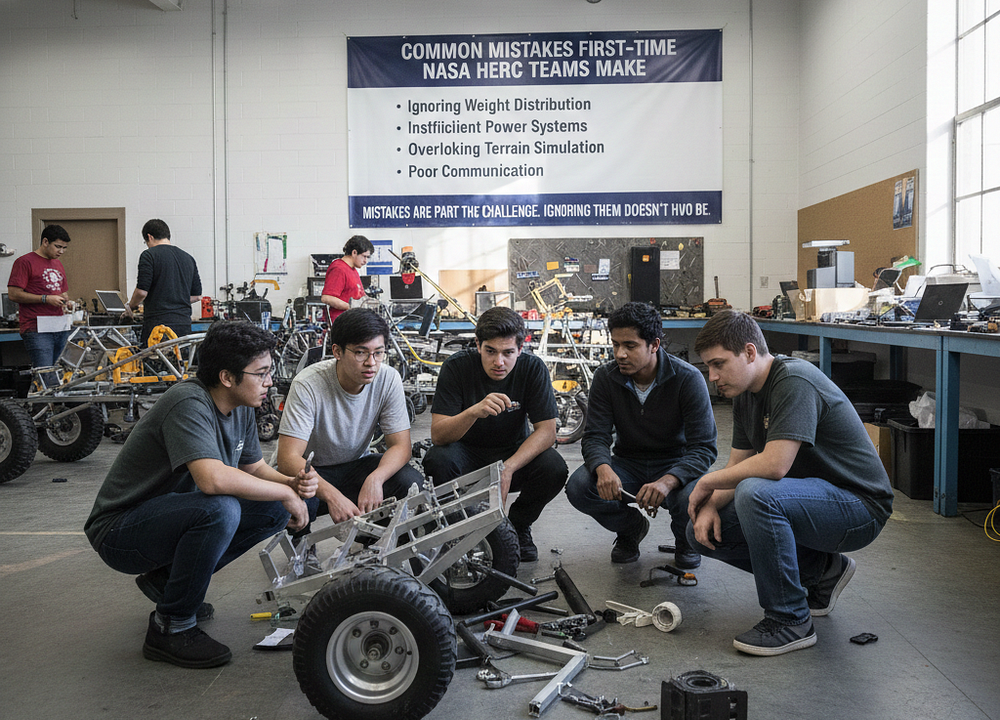
NASA HERC is an exciting competition, especially for first-time teams. The idea of designing and operating a rover for a NASA challenge is motivating, but it can also be overwhelming. Many teams arrive with strong enthusiasm and good intentions, yet struggle with avoidable issues along the way.
Most of these mistakes are not due to lack of talent. They come from inexperience with how complex engineering projects actually work under constraints. Based on what we observed and learned during NASA HERC 2025, here are some of the most common mistakes first-time teams tend to make.
Starting to Build Too Early
One of the most common mistakes is jumping straight into fabrication.
It’s tempting to start building as soon as an idea sounds exciting. But without clearly understanding requirements, constraints, and mission tasks, early builds often need major redesigns later.
First-time teams sometimes realise too late that a design does not meet size limits, safety expectations, or operational needs. Time spent planning and understanding the challenge saves far more time than it costs.
Treating the Rover as Separate Parts
Another mistake is designing subsystems in isolation.
Mechanical components, electrical systems, and control logic may work individually but fail when combined. Many first-time teams underestimate how strongly these systems affect one another.
NASA HERC evaluates the rover as a complete system. Ignoring integration early often leads to last-minute issues that are difficult to fix. Thinking in terms of systems instead of parts makes a huge difference.
Underestimating Testing Time
Testing is often treated as something to do at the end.
First-time teams frequently assume that once the rover works once, it will work consistently. In reality, repeated testing reveals problems that only appear over time.
Terrain behaviour, vibrations, alignment shifts, and control inconsistencies become visible only through frequent testing. Teams that leave testing too late lose valuable learning opportunities.
Overcomplicating the Design
Complex designs can look impressive, but they also increase risk.
First-time teams sometimes add features without fully considering whether they are necessary. More parts mean more failure points, higher maintenance, and more difficulty during operation.
NASA HERC rewards reliability and control more than complexity. Simple designs that are well understood often perform better than advanced designs that are not fully tested.
Ignoring Documentation Until the End
Documentation is often underestimated.
Some teams treat reports and reviews as paperwork rather than part of engineering. This usually results in rushed submissions and unclear explanations.
Documentation forces teams to think clearly about their design choices, safety considerations, and operational plans. When documentation is delayed, misunderstandings remain hidden until late in the process.
Strong documentation reflects strong understanding.
Not Practising as a Team
A rover that works well still needs a team that works well.
First-time teams sometimes focus only on the hardware and forget about practice. Operator coordination, communication, and decision-making under pressure are skills that require preparation.
NASA HERC is a team challenge. Practising together builds confidence and reduces mistakes during actual runs.
Assuming Competition Day Will Go as Planned
Competition environments are unpredictable.
Weather changes, time pressure increases, and unfamiliar terrain can affect performance. Teams that assume everything will go exactly as rehearsed often struggle when small things go wrong.
Prepared teams expect uncertainty and plan for it. Flexibility is as important as precision.
Focusing Only on Results
Another common mistake is focusing too much on scores.
NASA HERC is a learning-focused competition. Teams that chase results alone may miss opportunities to improve their understanding and process.
The most valuable outcomes often come from reflecting on what didn’t work and why. Growth matters more than a single performance metric.
What First-Time Teams Can Do Differently
The most successful teams are not the ones that avoid mistakes. They are the ones that identify them early and adapt.
Planning carefully, testing often, keeping designs simple, documenting clearly, and working as a coordinated team all help reduce avoidable issues.
Experience cannot be rushed, but awareness can.
Why These Lessons Matter
NASA HERC mirrors real engineering environments. Projects rarely fail due to lack of effort. They fail due to missed details, unclear planning, and weak coordination.
By learning from common mistakes, first-time teams can focus their energy where it matters most.
Team Mushak’s Perspective
For Team Mushak, observing and learning from mistakes played a major role in our growth after NASA HERC 2025. These lessons now shape how we approach NASA HERC 2026.
Sharing them is part of giving back to the student engineering community.
Looking Ahead
Mistakes are unavoidable in engineering. Learning from them is a choice.
As Team Mushak prepares for NASA HERC 2026, we continue to apply these lessons thoughtfully and intentionally.
This is Team Mushak.
Learning through challenges.
Building through iteration.
And preparing, one step at a time, for NASA HERC 2026
TO SEE OUR JOURNEY YOU GUYS CAN STAY TUNED WITH US ON
1. YouTube: https://youtube.com/@teammushak?si=pyRJ3G6mEWIp_YXz
2. Instagram: https://www.instagram.com/teammushak?igsh=cDBmYmZxdGoyZGwz
3. LinkedIn: linkedin.com/in/team-mushak
4. Twitter https://x.com/mushak_herc


Comments
Post a Comment