Designing for Terrain: Stability Comes First
Designing for Terrain: Stability Comes First
If the rover can’t stay upright, nothing else matters.
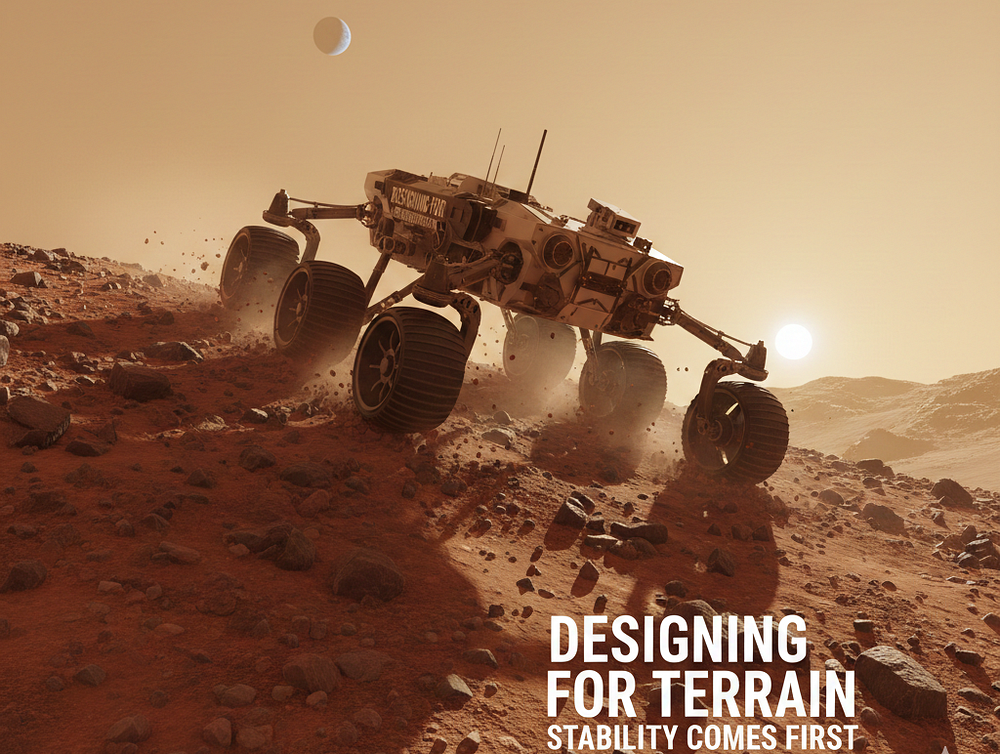
Planetary terrain does not forgive assumptions. Slopes, loose surfaces, uneven obstacles, and sudden changes in elevation challenge every design decision made long before competition day. In rover engineering, performance only matters if the system remains stable.
At NASA HERC, terrain is not just a backdrop. It is an active force that shapes how a rover behaves. Designing for terrain begins with a simple truth: stability comes first.
Terrain Is the First Design Constraint
When engineers imagine a rover, it is easy to picture it moving smoothly across a surface. In reality, planetary terrain is unpredictable. Surfaces vary in grip, resistance, and geometry, sometimes within a few metres.
This unpredictability forces designers to think beyond ideal motion. The rover must handle uneven loading, sudden shifts in balance, and repeated disturbances without losing control.
Terrain is not something a rover “overcomes.” It is something the rover must coexist with.
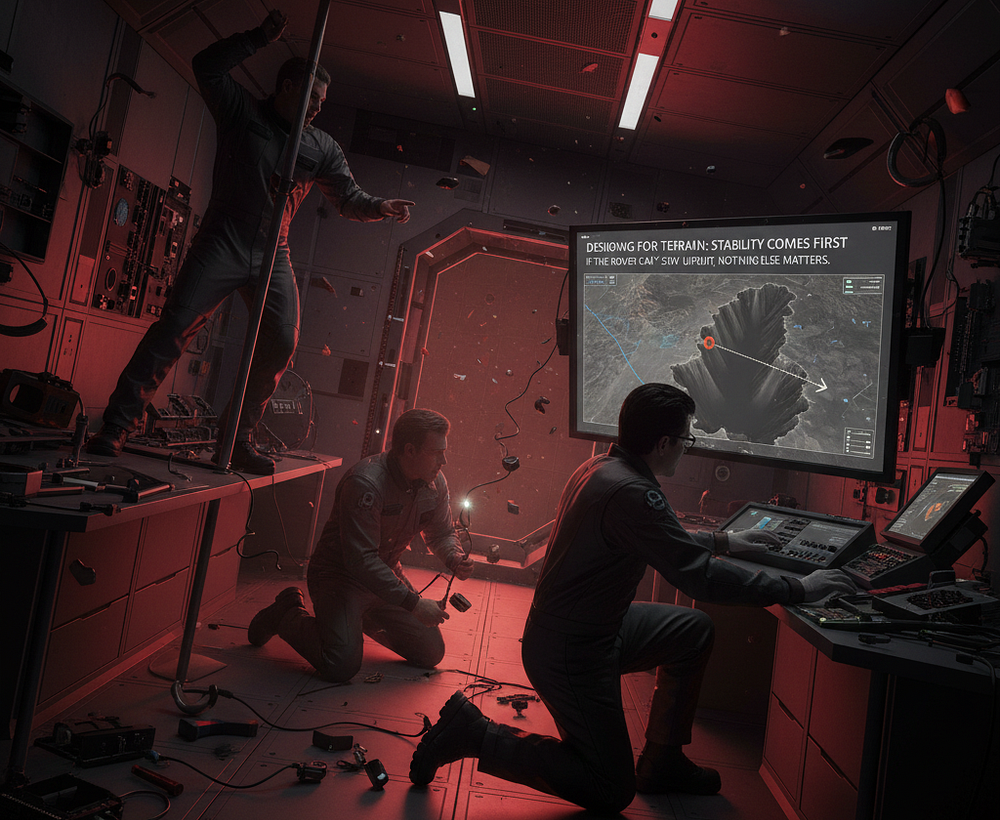
Why Balance Shapes Every Decision
Balance affects everything.
A rover that is powerful but poorly balanced will struggle on slopes. A rover that is fast but unstable becomes difficult to control. Balance determines how forces travel through the structure and how the system reacts to sudden changes.
Designing for balance means thinking carefully about layout, proportions, and load distribution. It requires awareness of how weight moves, not just where it sits.
At NASA HERC, balance is often tested indirectly. Small instabilities show up during turning, braking, or when crossing uneven features.
Understanding Centre of Mass
One of the most critical concepts in terrain design is the centre of mass.
A low, well-positioned centre of mass improves stability by reducing the likelihood of tipping. It also influences traction and control response. As terrain becomes more uneven, centre of mass placement becomes increasingly important.
Designers must consider not only static conditions but dynamic ones. Movement shifts forces. Acceleration and deceleration redistribute loads. What feels stable at rest may behave differently in motion.
Thinking about centre of mass early helps avoid costly redesigns later.
Stability Is More Than Not Tipping Over
Stability is often misunderstood as simply avoiding rollover. In practice, it is much broader.
A stable rover behaves predictably. It responds consistently to control inputs. It maintains contact with the ground in a controlled manner. It inspires confidence in operation.
On challenging terrain, predictability matters as much as strength. Systems that behave consistently are easier to control and easier to recover if something goes wrong.
NASA HERC rewards composure over aggression.
Terrain Reveals Weak Assumptions
Testing on realistic terrain exposes design assumptions quickly.
A layout that seems balanced on flat ground may lean unexpectedly on a slope. A configuration that performs well at low speed might behave differently when velocity increases slightly.
Terrain testing forces designers to confront reality. It highlights which assumptions hold and which need revisiting.
This is why terrain is such a powerful teacher in rover engineering.
Designing With Stability in Mind from the Start
Stability should not be added later. It should guide early decisions.
From initial sketches to layout selection, stability considerations influence proportions, orientation, and structure. Designing with terrain awareness early helps reduce compromises later.
This approach also supports adaptability. A stable foundation makes iteration easier and more effective.
Trade-Offs Are Inevitable
Designing for terrain always involves trade-offs.
Lowering the centre of mass may affect accessibility. Widening the stance may impact space usage. Increasing stability may reduce agility.
These trade-offs require prioritisation. Teams must decide what matters most based on mission goals and operating conditions.
NASA HERC helps teams practice making these decisions thoughtfully rather than instinctively.
Stability Builds Operator Confidence
Stability is not just a design concern. It affects the people operating the rover.
A rover that behaves smoothly and predictably reduces cognitive load on operators. Decisions become clearer. Control becomes more intuitive.
This human factor is often overlooked but plays a significant role during competition runs.
Good stability supports good teamwork.
Team Mushak’s Perspective
For Team Mushak, designing for terrain has reinforced the importance of fundamentals. Before adding features or capabilities, we focus on how the rover interacts with the ground beneath it.
This mindset shapes how we approach every design decision moving forward.
In rover engineering, terrain is never passive.
Designing for stability is not about limiting ambition. It is about ensuring that ambition stands on solid ground.
This is Team Mushak.
Learning through challenges.
Building through iteration.
And preparing, one step at a time, for NASA HERC 2026
TO SEE OUR JOURNEY YOU GUYS CAN STAY TUNED WITH US ON
1. YouTube: https://youtube.com/@teammushak?si=pyRJ3G6mEWIp_YXz
2. Instagram: https://www.instagram.com/teammushak?igsh=cDBmYmZxdGoyZGwz
3. LinkedIn: linkedin.com/in/team-mushak
4. Twitter https://x.com/mushak_herc


Comments
Post a Comment