From Idea to Rover: How a NASA HERC RC Rover Takes Shape
From Idea to Rover: How a NASA HERC RC Rover Takes Shape
Every rover begins as a question, not a machine.
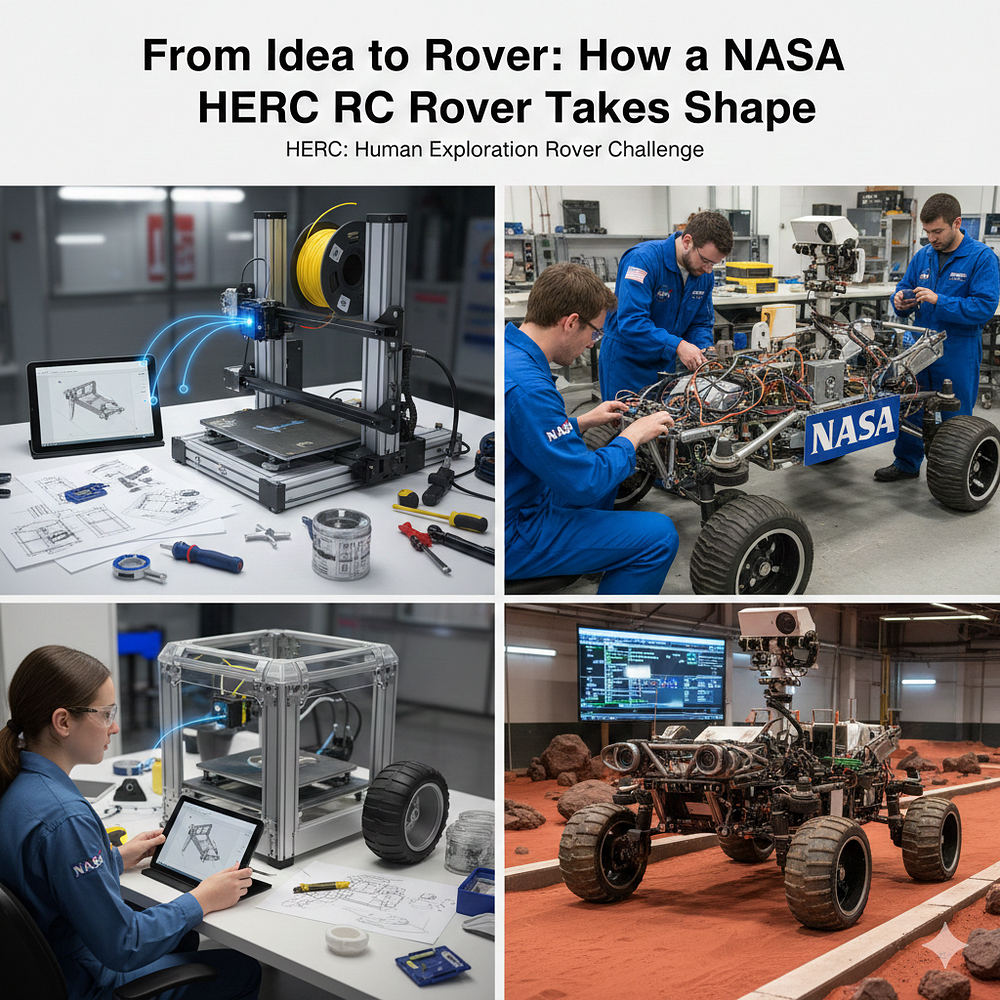
Building a rover for NASA HERC does not start with motors or metal. It starts much earlier, with conversations, rough ideas, and questions that don’t yet have clear answers.
The process of turning an idea into a functional RC rover is gradual. It involves thinking, testing, rethinking, and repeating. What emerges in the end is not a single moment of success, but a series of informed decisions shaped by learning.
Starting With the Problem, Not the Solution
The first step is always understanding what the rover needs to do. The competition defines mission tasks and operating conditions, but how a rover meets those requirements is left to the team.
At this stage, the goal is not to design components. It is to understand challenges. Terrain behaviour. Task expectations. Control requirements. Safety considerations.
Teams begin by asking what kind of rover would survive and function in these conditions. The focus stays broad. Ideas are allowed to be incomplete.
Early Concepts and Rough Thinking
Once the problem is clear, ideas begin to take form.
This part of the process is deliberately rough. Sketches are not precise. Concepts change quickly. Multiple approaches are considered without committing to any one direction too soon.
Some ideas seem promising at first but become impractical when viewed as a complete system. Others improve once limitations are acknowledged. This stage is less about correctness and more about exploration.
Good teams resist the urge to settle early.
Turning Concepts Into a System
As concepts mature, attention shifts from individual ideas to how they work together.
At this point, teams stop thinking in terms of parts and start thinking in terms of systems. Movement, power, control, and task execution must support each other rather than compete.
Design discussions become more structured. Every decision is questioned. How does this affect stability. How does this impact control. What happens if this fails.
This phase often reveals that simplifying one area improves performance everywhere else.
First Builds and Reality Checks
The moment when theory meets reality is always revealing.
Initial builds rarely behave exactly as expected. Components interact in ways that are difficult to predict on paper. Small imperfections have visible effects. Stability issues appear. Control feels different in practice.
Instead of treating these as failures, teams learn to treat them as data points. Each unexpected behaviour highlights something the design did not account for.
This is where engineering truly begins.
Iteration as a Mindset
Iteration is not about fixing mistakes once. It is about gradually improving understanding.
Teams adjust designs in small steps. Test again. Observe patterns. Make informed changes. Over time, these small refinements add up.
Iteration teaches patience. Rushing changes often creates new problems. Thoughtful iteration strengthens reliability.
NASA HERC rewards teams that improve steadily rather than chase dramatic redesigns.
Testing Beyond Functionality
Testing is not limited to whether the rover moves.
Teams test how consistently the rover behaves. How it responds to repeated use. How it handles minor disturbances. How predictable its controls feel.
Reliability becomes more important than impressive one time performance. A rover that behaves the same way every time builds confidence in both operators and design decisions.
This phase shapes how teams trust their systems.
Refinement Before Finalisation
As the competition approaches, the focus shifts from making changes to refining what already works.
Refinement involves tightening decisions rather than replacing them. Improving alignment. Adjusting control responses. Strengthening weak points without introducing new complexity.
At this stage, teams learn that knowing when to stop changing is as important as knowing when to improve.
Confidence grows not from perfection, but from predictability.
What This Process Teaches
The journey from idea to rover teaches far more than technical skills.
It builds decision making discipline. It encourages evidence based thinking. It trains teams to balance ambition with realism.
Most importantly, it shows that engineering is never a straight line. Progress comes through cycles of learning, not shortcuts.
Team Mushak’s Approach
For Team Mushak, this process continues to evolve. Every iteration teaches us something new about how our ideas translate into reality.
We don’t aim for perfect designs. We aim for designs we understand deeply.
That understanding is what allows improvement.
Looking Ahead
A rover is not shaped in a single moment. It is shaped through time, testing, and intention.
As Team Mushak prepares for NASA HERC 2026, we’ll keep sharing how our ideas grow into systems and how learning guides every decision.
This is Team Mushak.
Learning through challenges.
Building through iteration.
And preparing, one step at a time, for NASA HERC 2026
TO SEE OUR JOURNEY YOU GUYS CAN STAY TUNED WITH US ON
1. YouTube: https://youtube.com/@teammushak?si=pyRJ3G6mEWIp_YXz
2. Instagram: https://www.instagram.com/teammushak?igsh=cDBmYmZxdGoyZGwz
3. LinkedIn: linkedin.com/in/team-mushak
4. Twitter https://x.com/mushak_herc


Comments
Post a Comment