From Sketches to Structure: Early Design Decisions
Every line drawn is a decision made.
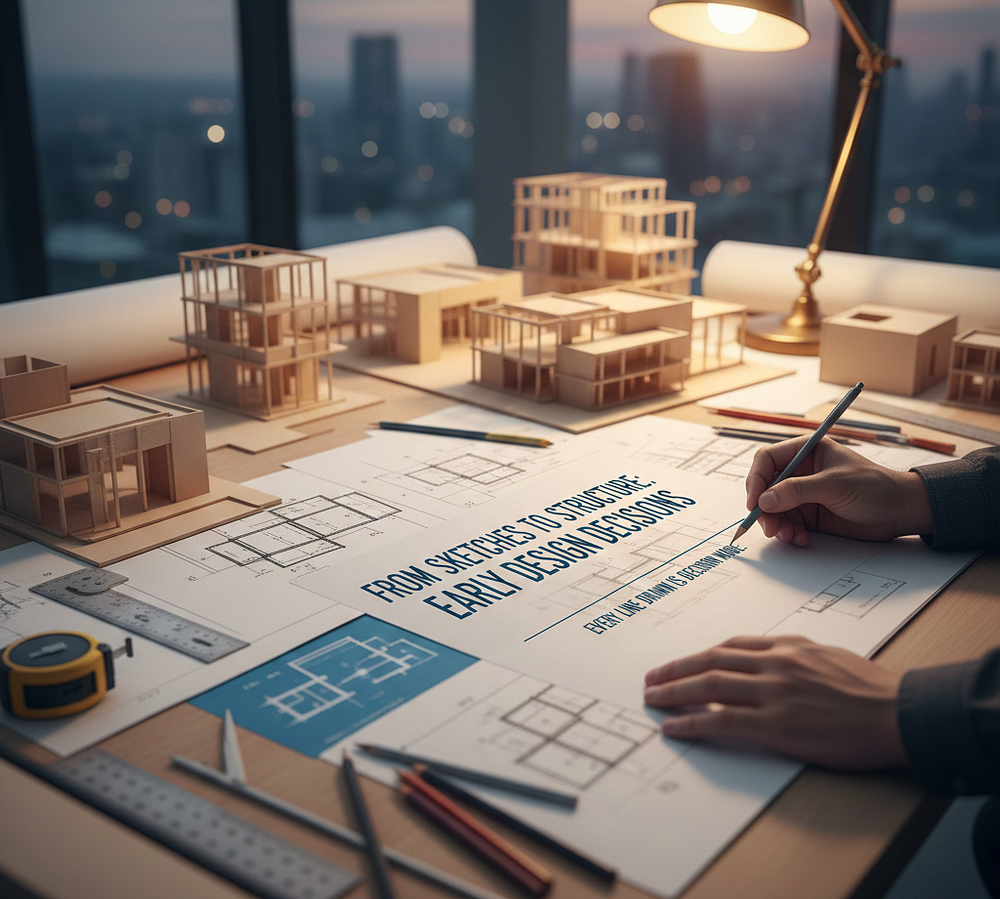
Before there is a rover, there are rough sketches. Unbalanced shapes. Crossed-out ideas. Half-formed concepts that exist only to explore possibilities.
Early design decisions in rover engineering do not look impressive. They look uncertain. But they are some of the most influential decisions made throughout the entire process.
At NASA HERC, these early moments shape everything that follows.
Why Sketches Matter More Than They Seem
Sketches are not about precision. They are about thinking.
At this stage, accuracy matters far less than clarity. Sketches help translate ideas from thought into form. They expose assumptions and highlight relationships that might otherwise stay hidden.
A sketch answers simple but critical questions. Where does this sit? How does this move? What connects to what?
Before models exist, sketches let engineers reason spatially.
The value of early sketches lies in their freedom.
Nothing is final. Ideas are tested mentally, not physically. Concepts can be discarded without loss. This encourages experimentation without pressure.
During this phase, multiple ideas often exist at once. Some contradict each other. That is intentional. Contrasting options reveal trade-offs early, when change is still easy.
NASA HERC rewards teams that explore before committing.
Trade-Offs Appear Early
Even at the sketching stage, trade-offs become visible.
A compact layout might simplify control but limit accessibility. A wide stance may improve stability but complicate transport. Decisions rarely come without consequences.
Sketches make these compromises tangible. They allow teams to compare options visually rather than hypothetically.
Recognising trade-offs early prevents costly redesigns later.
Eventually, exploration turns into selection.
The transition from rough ideas to a clear design direction is gradual. It happens through discussion, comparison, and questioning. No single sketch defines the outcome.
Early decisions are less about choosing the “best” option and more about choosing a direction that aligns with constraints, mission goals, and team capabilities.
This alignment matters more than perfection.
Avoiding Detail Too Soon
One common mistake in early design is adding detail prematurely.
At this stage, focusing on small features can hide bigger problems. Early design benefits from simplicity. Broad structure matters more than fine tuning.
By resisting detail, teams keep the design flexible. This allows adjustments as understanding improves.
NASA HERC encourages progression over perfection.
Design Is a Conversation
Early design decisions are rarely made alone.
Sketches often function as conversation starters rather than conclusions. They invite questions. They challenge assumptions. They help teams think together.
A sketch that sparks discussion is often more valuable than one that looks polished.
Collaboration strengthens early design thinking.
Accepting Uncertainty
Uncertainty is unavoidable at this stage.
Engineers do not yet know how systems will behave together. Some assumptions will turn out wrong. That is expected.
Strong teams accept uncertainty without rushing to eliminate it. They leave room for learning.
Early design decisions are most effective when they anticipate change rather than resist it.
Building a Foundation, Not a Final Form
The purpose of early design is not to create a finished rover. It is to establish a foundation.
These decisions influence layout flexibility, system integration, and ease of iteration. A thoughtful foundation simplifies later stages.
Poor early decisions make everything harder.
NASA HERC teaches that success is often determined long before competition day.
Team Mushak’s Approach
For Team Mushak, early design is treated as exploration, not execution. We sketch to understand, not to decide too quickly.
This approach reduces rework and encourages smarter iteration as the project progresses.
It reminds us that engineering is a process, not a moment.
Every rover begins as an idea on paper.
The care taken at this stage shapes everything that comes next.
From sketches to structure, early design decisions quietly define success.
This is Team Mushak.
Learning through challenges.
Building through iteration.
And preparing, one step at a time, for NASA HERC 2026
TO SEE OUR JOURNEY YOU GUYS CAN STAY TUNED WITH US ON
1. YouTube: https://youtube.com/@teammushak?si=pyRJ3G6mEWIp_YXz
2. Instagram: https://www.instagram.com/teammushak?igsh=cDBmYmZxdGoyZGwz
3. LinkedIn: linkedin.com/in/team-mushak
4. Twitter https://x.com/mushak_herc


Comments
Post a Comment