How Mechanical Design Impacts Rover Control System integration view.
How Mechanical Design Impacts Rover ControlSystem integration view.
Control doesn’t start with code — it starts with structure.
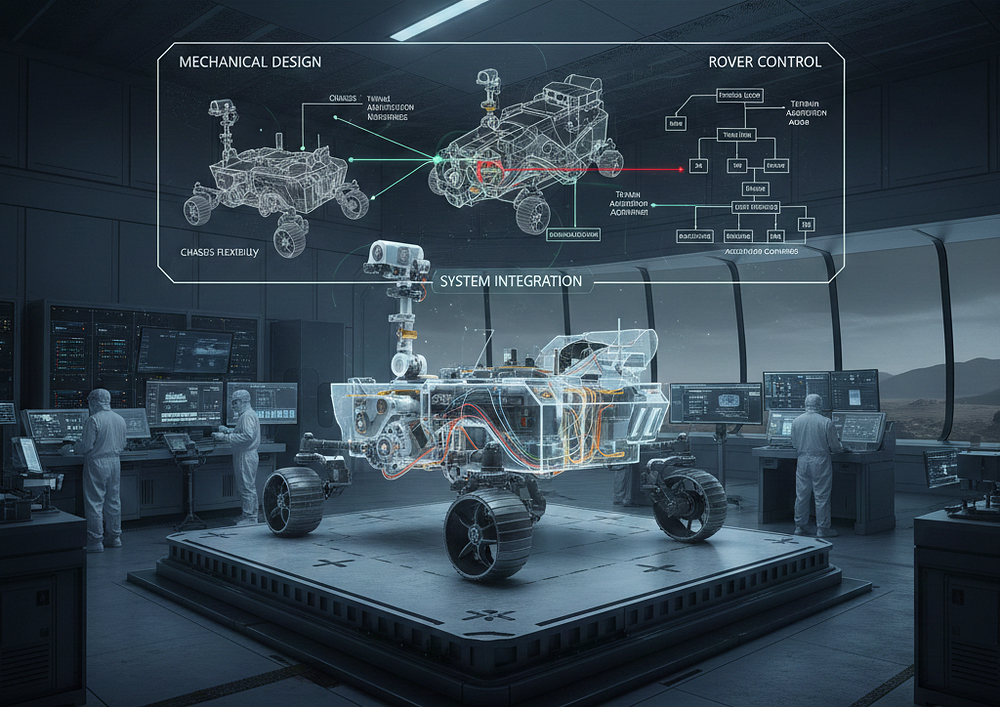
Rover control is often associated with electronics and software. But long before a controller sends its first command, mechanical design has already decided how the rover will respond.
In the NASA Human Exploration Rover Challenge RC Division, mechanical choices shape control behaviour in subtle but powerful ways. Stability, predictability, and responsiveness are not added later. They are built into the structure.
Understanding this connection is key to designing a rover that feels controlled rather than corrected.
Control Is a Physical Experience
Control is not only about signals and commands. It is about how the rover physically reacts to them.
When an input is given, the rover’s structure, mass distribution, and mechanical layout determine how smoothly that input becomes motion. Lag, drift, or overreaction often have mechanical roots.
If the rover behaves unpredictably, the issue is rarely software alone. Mechanical design sets the boundaries within which control systems operate.
Weight Distribution Shapes Responsiveness
One of the strongest influences on rover control is weight placement.
Uneven weight distribution affects turning behaviour, traction, and braking response. When mass shifts unexpectedly, control inputs feel exaggerated or delayed.
Well-balanced mechanical design leads to smoother acceleration and more predictable steering. Poor balance forces operators to compensate continuously.
At NASA HERC, controlled motion is more valuable than aggressive movement.
Structural Flex and Control Consistency
Structural rigidity plays a quiet but critical role.
Excessive flex introduces delay between command and response. Forces are absorbed unpredictably, reducing the precision of movement. Inconsistent stiffness across the structure creates uneven response across different motions.
However, absolute rigidity is not the goal. The structure must absorb shocks while maintaining predictable response.
Effective mechanical design manages flex rather than eliminating it.
Wheel and Suspension Interaction
Control is only as good as ground contact.
Wheel design influences how traction builds and releases. Suspension affects how consistently wheels stay engaged with the terrain. Together, they dictate how smoothly commands translate into movement.
Poor interaction leads to slipping, sudden grip loss, or uneven turning. Well-matched systems create steady, controllable motion even on uneven surfaces.
Mechanical integration decides whether control feels intuitive or reactive.
Mechanical Simplicity Improves Control
Complex mechanical systems introduce variables.
More joints, linkages, and moving parts increase uncertainty. Each additional degree of freedom affects predictability and responsiveness.
Simpler mechanical designs often result in better control because behaviour is easier to anticipate and manage. NASA HERC designs reward clarity over complexity.
Reliability enhances control as much as precision.
Testing Reveals Control Limitations
Control weaknesses become obvious during testing.
The rover may respond differently on slopes, uneven ground, or under load. These moments expose mechanical factors influencing control quality.
Testing allows teams to observe patterns rather than symptoms. Adjustments can then focus on structure, mass, and interface design instead of forcing software to compensate.
Good control emerges from mechanical confidence.
System Integration Is the Key
Mechanical, electrical, and control systems do not operate independently.
Mechanical design sets the physical reality that electrical and control systems must respect. When integration is thoughtful, control feels natural. When it is forced, systems fight each other.
NASA HERC encourages teams to treat rover design as a single system rather than separate subsystems.
Team Mushak’s Perspective
For Team Mushak, control begins at the design table.
We view mechanical design as the first layer of control. By prioritizing balance, predictability, and structural clarity, we allow control systems to operate effectively rather than defensively.
This approach reduces the need for compensation and increases confidence during operation.
Control is not something added at the end of the build.
It is shaped by every mechanical choice made along the way.
In NASA HERC, rovers that feel controlled are the result of integrated thinking, not isolated optimization.
True control starts before the first command is ever sent.
This is Team Mushak.
Learning through challenges.
Building through iteration.
And preparing, one step at a time, for NASA HERC 2026
TO SEE OUR JOURNEY YOU GUYS CAN STAY TUNED WITH US ON
1. YouTube: https://youtube.com/@teammushak?si=pyRJ3G6mEWIp_YXz
2. Instagram: https://www.instagram.com/teammushak?igsh=cDBmYmZxdGoyZGwz
3. LinkedIn: linkedin.com/in/team-mushak
4. Twitter: https://x.com/mushak_herc
5. Blogger: https://teammushak.blogspot.com/2026/01/the-vision-behind-team-mushak.html
6.Medium: https://medium.com/@team.mushak/key-design-lessons-from-nasa-herc-2025-6a7c83a2ee73


Comments
Post a Comment