Mechanical Failures We Encountered During Testing
Mechanical Failures We Encountered During Testing
Every breakdown carried a blueprint for improvement.
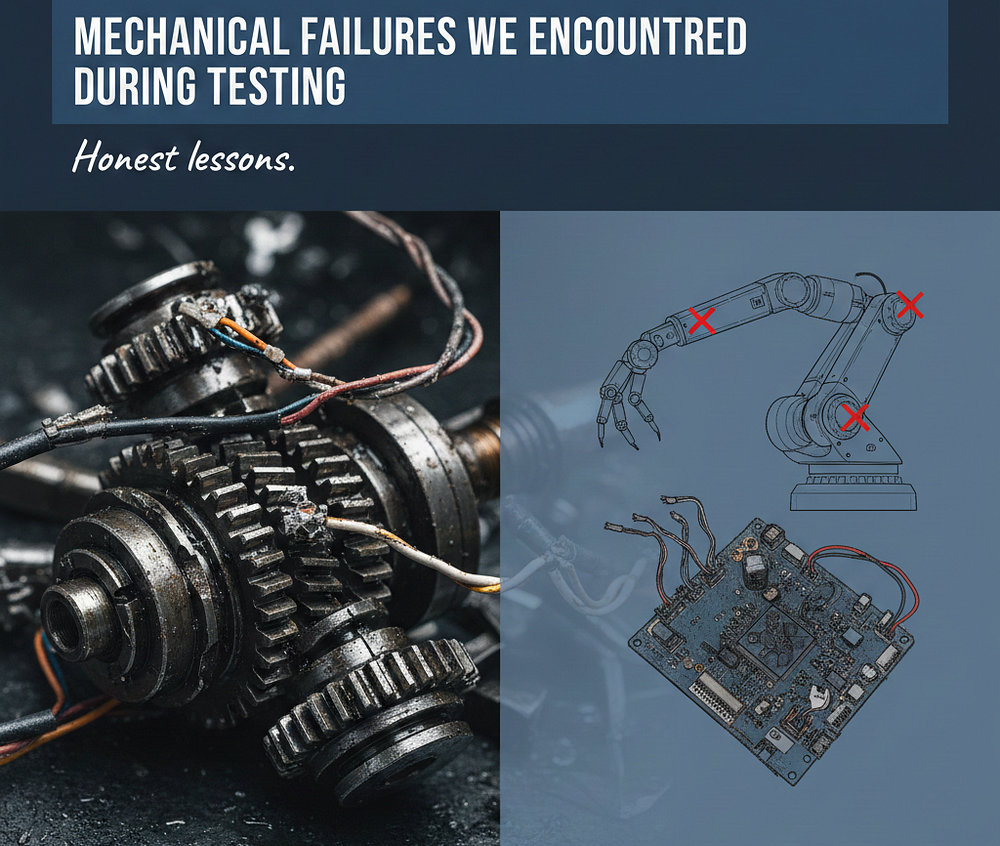
Testing is where ideas meet resistance.
In the NASA Human Exploration Rover Challenge RC Division, mechanical systems are pushed far beyond the comfort of theory. Rovers experience uneven terrain, repeated loading, and dynamic forces that no design sketch can fully predict. For Team Mushak, testing was not only about verifying success. It was about discovering failure.
Those moments taught us some of our most valuable lessons.
Why Mechanical Failures Matter
Mechanical failures during testing are not signs of poor engineering. They are signs that the system is being used realistically.
Testing exposes assumptions. It highlights where designs are overconfident, underprepared, or simply unaware of real-world conditions. Mechanical issues reveal how forces actually travel through the rover rather than how they were expected to.
At NASA HERC, teams are evaluated not by the absence of problems, but by how thoughtfully they respond to them.
Stress Appears Where You Least Expect It
One of the first lessons we learned was that stress rarely behaves politely.
Components that seemed secure under static inspection behaved differently once the rover moved over terrain. Repeated vibration and uneven loading revealed weaknesses that were not immediately visible.
These moments taught us to look beyond individual parts and examine load paths across the entire structure. Failure helped us understand which areas demanded reinforcement and which could be simplified.
Mechanical systems do not fail randomly. They fail where stress accumulates silently.
Alignment Matters More Than It Looks
Small misalignments can create large problems.
During testing, we observed that even minor deviations in alignment affected motion and durability. Components experienced uneven wear, connections loosened faster, and movement felt less predictable.
These issues highlighted the importance of precision and consistency during assembly. Mechanical reliability depends not only on design quality but also on execution.
Testing emphasized that precision is not perfectionism. It is preventative engineering.
Overbuilding Can Create Its Own Problems
In early iterations, some components were reinforced more than necessary.
While this initially felt safe, testing revealed unintended consequences. Added mass increased stress on adjacent systems, influenced weight distribution, and affected how the rover responded to terrain.
Mechanical failure is not always caused by weakness. Sometimes it is caused by excess.
Learning where strength is required, and where it becomes a liability, changed how we approached design refinement.
Fast Fixes Rarely Last
Testing created pressure to respond quickly.
Early on, temporary fixes seemed appealing. They restored function but failed to address root causes. Over time, these quick solutions introduced inconsistencies and new points of failure.
This taught us the value of stepping back instead of reacting impulsively. Mechanical failures often require reflection as much as repair.
NASA HERC rewards teams that prioritize long-term reliability over short-term convenience.
Iteration Turned Failure Into Confidence
Each failure improved our understanding.
As testing continued, our responses became more measured. We documented issues, identified patterns, and adjusted designs deliberately. What initially felt disruptive gradually became informative.
The rover’s behavior became more predictable. Failures became less frequent and more understandable.
Iteration did not eliminate problems immediately. It made them manageable.
Failure Strengthened Team Communication
Mechanical failures affected more than hardware.
They shaped how the team communicated. Issues required discussion across subsystems. Decisions had to balance structural concerns, electrical integration, and operational constraints.
This collaboration improved system awareness and reduced silos. Problems became shared responsibilities rather than isolated frustrations.
Strong teams are built under pressure.
What These Failures Taught Us
Testing showed us that mechanical reliability is not achieved through confidence alone. It is earned through observation, correction, and restraint.
Failure sharpened our judgment. It taught us patience, discipline, and respect for real-world complexity.
For Team Mushak, these lessons now guide how we design, test, and iterate as we prepare for NASA HERC 2026.
Mechanical failure is not the opposite of progress.
It is part of the path toward it.
Every breakdown revealed what the rover needed to become stronger, calmer, and more reliable.
At NASA HERC, learning is built from stress as much as from success.
This is Team Mushak.
Learning through challenges.
Building through iteration.
And preparing, one step at a time, for NASA HERC 2026
TO SEE OUR JOURNEY YOU GUYS CAN STAY TUNED WITH US ON
1. YouTube: https://youtube.com/@teammushak?si=pyRJ3G6mEWIp_YXz
2. Instagram: https://www.instagram.com/teammushak?igsh=cDBmYmZxdGoyZGwz
3. LinkedIn: linkedin.com/in/team-mushak
4. Twitter: https://x.com/mushak_herc
5. Blogger: https://teammushak.blogspot.com/2026/01/the-vision-behind-team-mushak.html
6.Medium: https://medium.com/@team.mushak/key-design-lessons-from-nasa-herc-2025-6a7c83a2ee73


Comments
Post a Comment