Motor Control and Speed Limitation in NASA HERC
Motor Control and Speed Limitation in NASA HERC
In rover engineering, control earns more trust than speed.
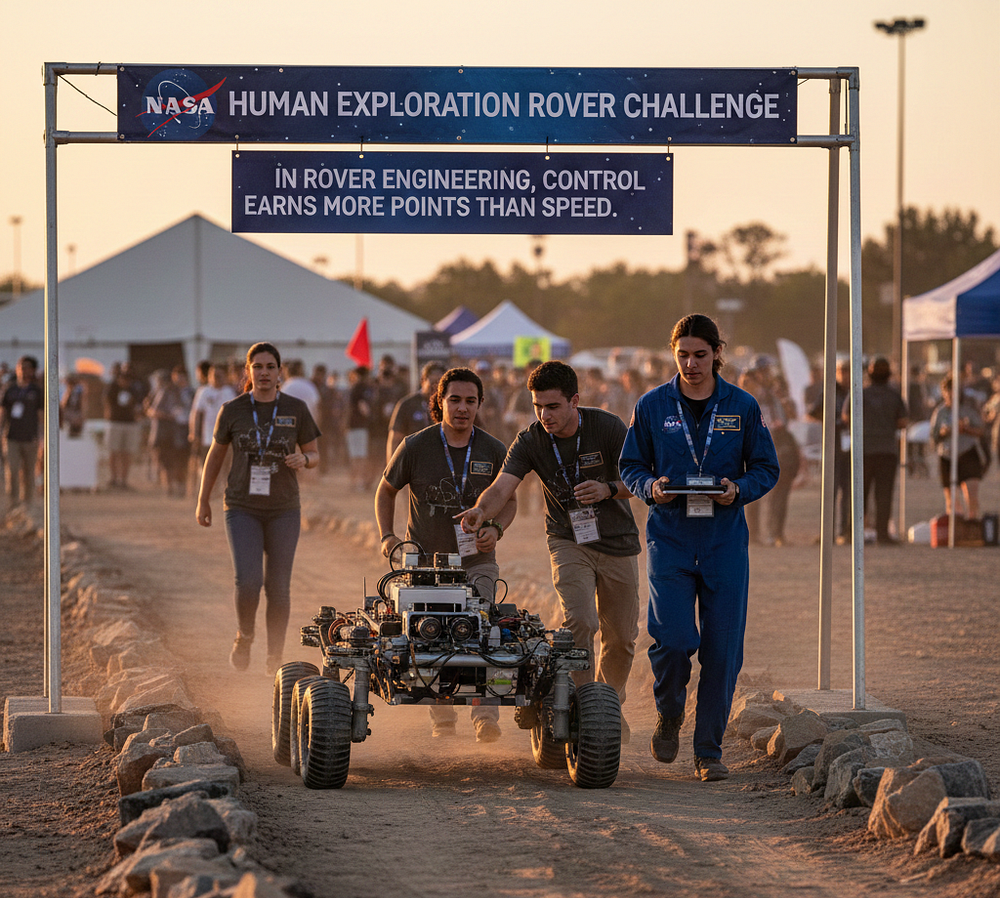
In many engineering projects, speed is often seen as a sign of performance. Faster systems feel powerful and impressive. In NASA HERC, however, speed is not the goal. Control is.
Motor control and speed limitation are central to how an RC rover behaves, how safely it operates, and how reliably it completes tasks. NASA HERC places clear limits on speed not to reduce capability, but to encourage thoughtful engineering.
Why Speed Is Intentionally Limited.Speed limits in NASA HERC are not arbitrary.
They exist because planetary exploration is not about racing. It is about precision, safety, and consistency in uncertain environments. Uneven terrain, loose surfaces, and obstacles demand careful motion rather than aggressive movement.
By limiting speed, NASA HERC shifts the focus from how fast a rover can move to how well it can be controlled.
This mirrors real exploration missions, where reliability matters far more than velocity.
Motor Control Shapes Rover Behaviour
Motors do more than create motion. They define how motion feels.
Smooth acceleration, predictable braking, and consistent response to commands all depend on good motor control. Poor control can make even a well-built rover difficult to operate.
In challenging terrain, sudden movements amplify instability. Controlled motion reduces the risk of slipping, tipping, or losing orientation.
NASA HERC encourages teams to design systems that behave calmly and predictably under all conditions.
A rover is only as effective as its operator’s confidence in it.When control responses are consistent, operators can anticipate behaviour. This reduces hesitation and improves decision-making during runs.
Speed without control increases cognitive load. Operators must constantly compensate for unpredictable behaviour. Over time, this leads to errors.
Control-focused design supports smoother teamwork and clearer communication during operation.
Stability Depends on Controlled Motion
Stability is not static. It changes as the rover moves.
Acceleration, turning, and stopping all shift forces through the structure. Higher speeds magnify these forces and increase the likelihood of instability.
Speed limitation helps keep these forces within manageable ranges. It allows the rover to maintain contact with the terrain and respond gracefully to changes.
In NASA HERC, stability gained through control often outweighs any advantage gained through speed.Precision Matters During Tasks.Many rover tasks require positioning accuracy.
Approaching a site, aligning correctly, and maintaining position all depend on controlled movement. Excessive speed makes precision harder, not easier.
Well-controlled motor behaviour allows fine adjustments and steady positioning. This improves task execution and reduces recovery time if something goes slightly wrong.
NASA HERC rewards rovers that can move with intent, not urgency.
Safety Is Closely Linked to Motor Control
Motor control directly affects safety.
Uncontrolled motion increases risk to the rover, the environment, and the people nearby. Speed limitation reduces these risks by ensuring predictable behaviour.
Designing for safe motion means planning for normal operation and unexpected situations. Controlled systems are easier to stop, stabilise, and recover.
NASA evaluates how responsibly teams approach these considerations.
At higher speeds, issues may go unnoticed temporarily.Momentum can mask uneven traction, imbalanced layouts, or delayed responses. When speed is reduced, these issues become visible.
Speed limitation encourages teams to address underlying design quality rather than relying on momentum.
This leads to stronger, more honest engineering outcomes.
Engineering Judgement Over Raw Capability
NASA HERC challenges teams to demonstrate judgement.
Choosing control over speed reflects maturity. It shows that the team understands the environment, the mission, and the responsibilities involved.
Good motor control demonstrates that performance is measured by reliability and predictability, not spectacle.
This mindset aligns closely with real-world engineering practice.
Team Mushak’s Perspective
For Team Mushak, motor control is treated as a foundation, not a feature. We focus on smooth behaviour, predictable response, and safe operation.
This approach helps ensure that the rover remains manageable across varying conditions and that the team can operate with confidence.Closing Thought
Speed is easy to notice. Control is easy to underestimate.
In NASA HERC, controlled motion defines how well a rover truly performs. It supports stability, safety, precision, and teamwork.
By valuing control over speed, teams learn one of the competition’s most important lessons.
Good engineering moves with intention.
This is Team Mushak.
Learning through challenges.
Building through iteration.
And preparing, one step at a time, for NASA HERC 2026
TO SEE OUR JOURNEY YOU GUYS CAN STAY TUNED WITH US ON
1. YouTube: https://youtube.com/@teammushak?si=pyRJ3G6mEWIp_YXz
2. Instagram: https://www.instagram.com/teammushak?igsh=cDBmYmZxdGoyZGwz
3. LinkedIn: linkedin.com/in/team-mushak
4. Twitter https://x.com/mushak_herc


Comments
Post a Comment