Suspension Systems and Stability Challenges
Suspension Systems and Stability Challenges
Staying grounded on ground that never cooperates.
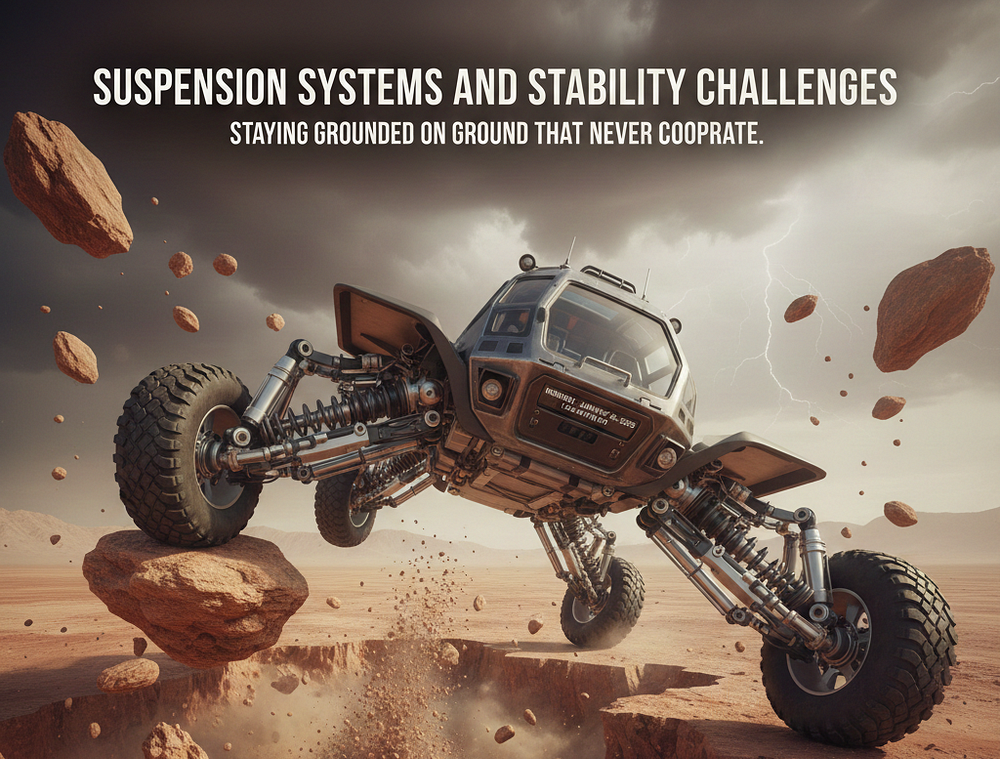
In the NASA Human Exploration Rover Challenge RC Division, terrain is not designed to be kind. It is uneven, unpredictable, and deliberately challenging. Slopes change quickly, obstacles interrupt motion, and loose surfaces test control at every step. In this environment, suspension systems play a critical role in keeping the rover stable, controllable, and reliable.
Suspension is not about comfort. It is about maintaining contact, managing forces, and protecting the rover as it moves through unfamiliar ground.
Why Suspension Matters on Simulated Planetary Terrain
Planetary terrain rarely offers smooth paths. In NASA HERC, obstacles are scaled to reflect this reality. Rovers encounter variations in height, resistance, and firmness that demand constant mechanical adaptation.
Suspension systems help distribute loads across the rover and allow wheels to respond independently to terrain changes. Without this adaptability, a single uneven surface can destabilize the entire system.
Good suspension improves traction, protects structural components, and supports predictable driving behaviour. It allows the rover to respond to the terrain instead of fighting against it.
Stability Begins With Contact
A rover’s stability starts at the ground.
Maintaining consistent wheel contact is essential for control. When one or more wheels lose contact, traction drops and steering becomes unreliable. Suspension helps keep wheels engaged with the surface even when the terrain changes suddenly.
Stability is also influenced by how forces travel through the rover. Suspension systems absorb impacts and reduce the transmission of sudden loads to the structure.
This load management reduces stress on components and improves overall reliability during repeated runs and testing.
Balancing Flexibility and Control
Suspension design is a balance between flexibility and restraint.
Too much stiffness limits adaptation to uneven terrain. Too much flexibility introduces instability and unpredictable motion. The challenge lies in finding a balance that supports movement without compromising control.
In NASA HERC, suspension systems must support consistent behaviour rather than extreme performance. Controlled response is valued more than aggressive articulation.
Design choices reflect an understanding of trade-offs rather than a search for perfection.
Center of Mass and Rollover Risk
Suspension cannot be evaluated without considering the rover’s center of mass.
Terrain challenges often involve inclines and uneven loading. As the rover moves, its weight shifts dynamically. A poorly managed center of mass increases rollover risk and reduces control.
Suspension systems influence how the rover reacts to these shifts. Stable suspension supports controlled weight transfer and helps the rover maintain balance on uneven surfaces.
Understanding how suspension interacts with mass distribution is essential for safe and reliable operation.
Learning Stability Through Testing and Iteration
Suspension behaviour cannot be fully understood through design alone.
Testing reveals how the rover responds to real terrain. Small changes in surface conditions can expose weaknesses in stability planning. Repeated testing helps teams identify patterns rather than one-time failures.
Iteration allows teams to refine how the suspension responds to movement, obstacles, and load transfer. Over time, the rover becomes more predictable and stable.
NASA HERC emphasizes learning through testing because it mirrors real engineering development.
Suspension systems are often invisible during success and immediately noticeable during failure.
They quietly determine whether a rover remains stable, controllable, and safe across challenging terrain. In the RC Division, suspension design reflects a team’s understanding of terrain realism and mechanical responsibility.
Stability is not accidental. It is designed, tested, and refined.
At NASA HERC, staying grounded is not just a mechanical challenge.
It is an engineering mindset.
This is Team Mushak.
Learning through challenges.
Building through iteration.
And preparing, one step at a time, for NASA HERC 2026
TO SEE OUR JOURNEY YOU GUYS CAN STAY TUNED WITH US ON
1. YouTube: https://youtube.com/@teammushak?si=pyRJ3G6mEWIp_YXz
2. Instagram: https://www.instagram.com/teammushak?igsh=cDBmYmZxdGoyZGwz
3. LinkedIn: linkedin.com/in/team-mushak
4. Twitter: https://x.com/mushak_herc
5. Blogger: https://teammushak.blogspot.com/2026/01/the-vision-behind-team-mushak.html
6.Medium: https://medium.com/@team.mushak/key-design-lessons-from-nasa-herc-2025-6a7c83a2ee73


Comments
Post a Comment