The Mechanical Anatomy of a NASA HERC RC Rover
The Mechanical Anatomy of a NASA HERC RC Rover
Where structure, motion, and purpose come together.
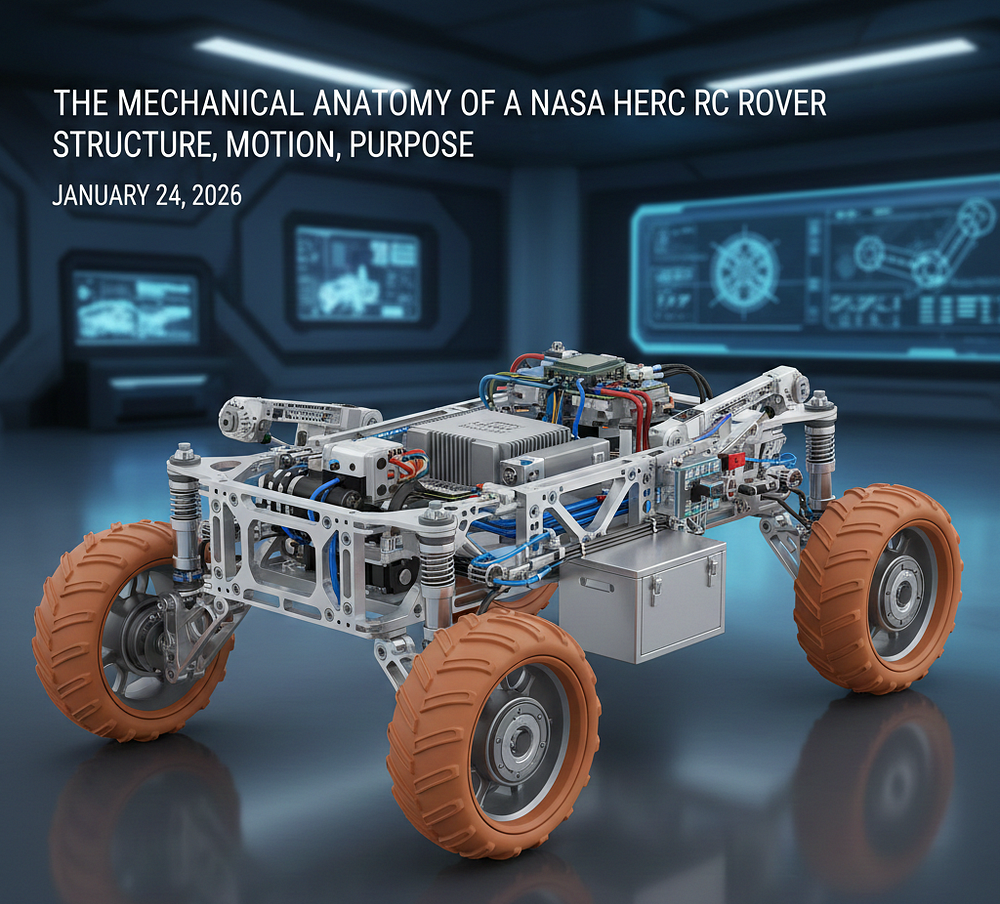
When people think of a rover, they often picture wheels moving over rugged terrain. But beneath that motion lies a carefully designed mechanical system that decides whether the rover survives the course or struggles against it.
In the NASA Human Exploration Rover Challenge RC Division, mechanical design is not just about building something that moves. It is about building something that endures, adapts, and performs under unpredictable conditions.
Understanding the mechanical anatomy of a rover means understanding how every physical part works together as a system.
The Rover as a System, Not a Collection of Parts
A NASA HERC RC rover is not a set of independent components assembled together. It is an integrated mechanical system where structure, motion, and load paths are deeply connected.
Every mechanical decision affects something else. A change in frame design influences stability. Suspension decisions affect control. Weight distribution impacts traction and turning behaviour.
This interconnection is what makes mechanical engineering both challenging and rewarding.
The Structural Framework: The Rover’s Backbone
At the core of the rover lies its structural framework.
This structure supports every other subsystem. It carries loads, protects internal components, and maintains alignment under stress. During a run, the rover experiences vibration, uneven terrain, and repeated impacts. The structure must handle these forces without deforming or failing.
A well-designed structure balances strength and efficiency. It avoids unnecessary mass while remaining rigid enough to support operation under dynamic conditions.
In NASA HERC, structural design reflects how well a team understands real-world mechanical demands.
Mobility Systems: How the Rover Moves
Movement is one of the most visible aspects of a rover, but its mechanics are carefully considered.
Mobility systems include wheels, drive layouts, and supporting components that allow the rover to navigate obstacles. These systems must handle loose surfaces, slopes, and uneven ground while maintaining traction and control.
Mechanical mobility design prioritises reliability over speed. The goal is not aggressive movement, but consistent and predictable behaviour across the course.
NASA HERC rewards control, not rush.
Suspension and Stability: Staying Grounded. Terrain is rarely forgiving.
Suspension and stability mechanisms help the rover maintain contact with the ground while adapting to surface changes. These systems distribute loads and reduce the impact of sudden height changes or obstacles.
Good stability design improves traction and reduces stress on the structure. Poor stability leads to loss of control and increased risk of mechanical failure.
Mechanical stability is often the difference between completing an obstacle smoothly and struggling halfway through it.
Every rover carries loads. Mechanical engineers must understand how forces move through the structure. These load paths determine where stress concentrates and where reinforcement is necessary.
Proper stress management ensures that no single component carries an unreasonable burden. It also reduces fatigue over repeated runs and testing cycles.
At NASA HERC, understanding load behaviour is essential for long-term reliability.
Mechanical Interfaces: Where Systems Meet
Mechanical design does not exist in isolation.
Interfaces between mechanical, electrical, and control systems must be planned carefully. Mounting points, access panels, and enclosure designs all influence how the rover is assembled, tested, and maintained.
Good interfaces simplify inspection and troubleshooting. They make iteration easier and reduce the chance of accidental damage during testing.
NASA HERC encourages designs that are thoughtful not just in performance, but in usability.
Mechanical anatomy is shaped by constraints. Size limits, weight limits, safety requirements, and course conditions all influence mechanical decisions. These constraints are not obstacles to creativity. They are frameworks that guide responsible engineering.
Working within constraints forces teams to prioritise functionality, reliability, and clarity of purpose.
In NASA HERC, constraints help simulate real engineering environments where trade-offs are unavoidable.
Why the Big Picture Matters?
Focusing only on individual parts misses the point.
A rover succeeds when its mechanical systems work together seamlessly. Strength without stability fails. Mobility without control struggles. Structure without thoughtful interfaces complicates operation.
Understanding the full mechanical anatomy allows teams to make better decisions during design, testing, and iteration.
Team Mushak’s Approach
For Team Mushak, mechanical design begins with system thinking. We look at how structure, mobility, and stability interact rather than treating them separately.
This big-picture approach helps us prepare for real conditions rather than ideal assumptions.
The mechanical anatomy of a NASA HERC RC rover tells the story of how engineering principles meet physical reality.
It is where design choices become forces, motion, and outcomes.
As we move forward, we will explore these mechanical systems in more detail. For now, understanding the whole helps us build every part better.
This is Team Mushak.
Learning through challenges.
Building through iteration.
And preparing, one step at a time, for NASA HERC 2026
TO SEE OUR JOURNEY YOU GUYS CAN STAY TUNED WITH US ON
1. YouTube: https://youtube.com/@teammushak?si=pyRJ3G6mEWIp_YXz
2. Instagram: https://www.instagram.com/teammushak?igsh=cDBmYmZxdGoyZGwz
3. LinkedIn: linkedin.com/in/team-mushak
4. Twitter: https://x.com/mushak_herc
5. Blogger: https://teammushak.blogspot.com/2026/01/the-vision-behind-team-mushak.html
6.Medium: https://medium.com/@team.mushak/key-design-lessons-from-nasa-herc-2025-6a7c83a2ee73


Comments
Post a Comment