Wheel Design and Traction on Planetary Terrain
Wheel Design and Traction on Planetary Terrain
Because movement starts where rubber meets reality.
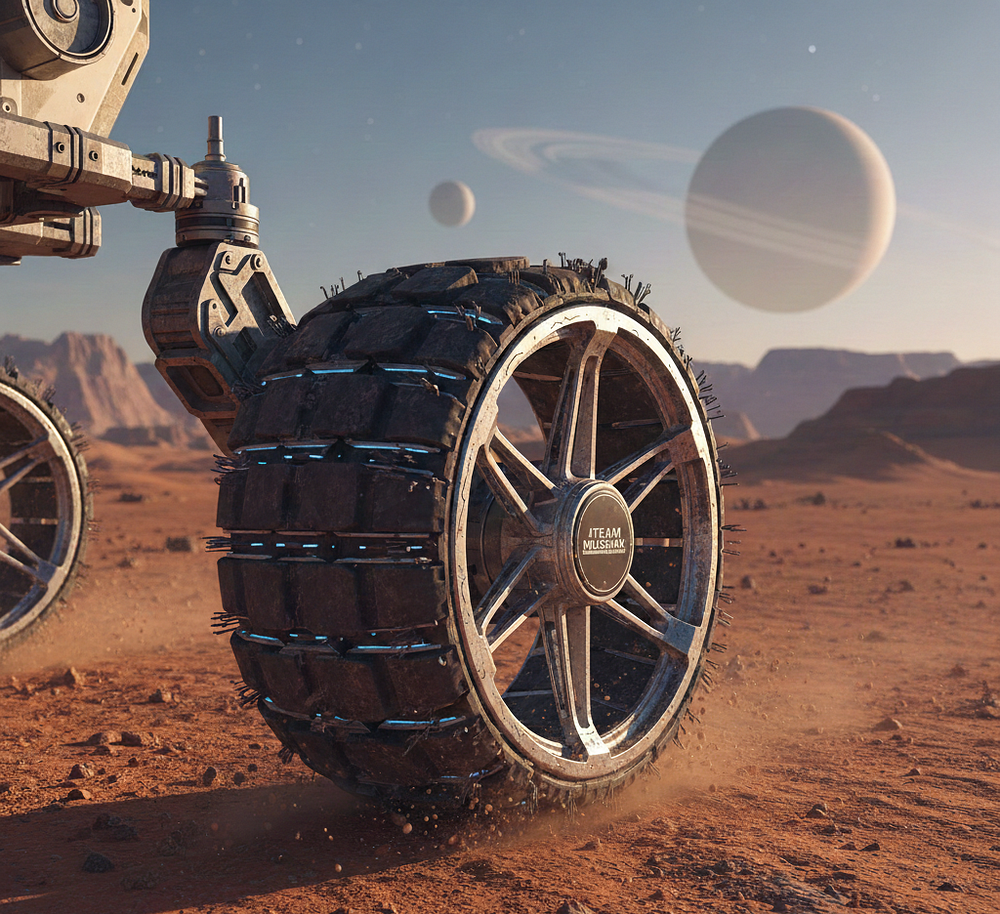
In the NASA Human Exploration Rover Challenge RC Division, wheels are often judged first by how they look. But their real test begins once the rover touches the ground.
Traction, stability, and control all originate at the wheel–terrain interface. No matter how advanced the electronics or how rigid the structure, a rover that cannot grip the surface will struggle to perform.
Wheel design is not a detail. It is a foundation.
Planetary Terrain Is Unpredictable by Design
The HERC course is intentionally challenging.
Teams face surfaces that vary in firmness, texture, and resistance. Loose material, uneven obstacles, and changing inclines demand wheels that adapt rather than specialize too narrowly.
Planetary terrain does not reward perfection under ideal conditions. It rewards consistency under uncertainty.
This is why wheel design focuses less on theoretical efficiency and more on practical reliability.
Why Custom Wheels Matter in NASA HERC
NASA HERC requires teams to design their own wheels, and this rule is deliberate.
Commercial wheels are designed for controlled environments. HERC wheels must perform across varied conditions while complying with strict constraints. Designing wheels forces teams to confront real engineering trade-offs.
Material choice, geometry, and contact surface all influence performance. Teams must decide what matters most for their rover’s mission profile.
Custom wheels reflect a team’s understanding of terrain, constraints, and system behaviour.
Traction Is About Balance, Not Aggression
More traction does not always mean better performance.
Aggressive designs can dig in too deeply, increase resistance, or destabilize the rover during turns. Overly smooth designs may fail to grip loose surfaces.
Effective traction balances grip with control.
Wheel designs must provide enough surface interaction to move confidently without compromising steering or stability. This balance depends on terrain type, rover weight, and drive characteristics.
At NASA HERC, traction is judged by outcomes, not intentions.
Wheel Geometry Shapes Rover Behaviour
The shape of a wheel influences more than traction.
Diameter affects obstacle clearance and torque requirements. Width influences ground pressure and stability. Surface patterns alter how forces are distributed across terrain.
These choices affect how the rover accelerates, turns, and responds to uneven ground. A small change in geometry can alter overall handling significantly.
Wheel design becomes a system-level decision rather than an isolated component.
Durability Matters as Much as Grip
HERC is not a single-moment challenge.
Rovers must survive repeated testing, transportation, and multiple runs. Wheels experience continuous stress, deformation, and contact forces.
Durable wheel design ensures consistent performance across time, not just during initial trials. Failure late in testing teaches a different lesson than failure during competition.
NASA values systems that endure.
Weight and Efficiency Are Always Present
Wheel design also affects weight distribution and energy usage.
Heavier wheels increase inertia and demand more power during acceleration and braking. Lighter wheels may reduce resistance but introduce durability concerns.
Teams must balance mechanical strength with efficiency while remaining within competition limits.
These decisions reinforce how interconnected mechanical systems truly are.
Testing Turns Assumptions into Insight
Wheel performance cannot be fully predicted on paper.
Testing reveals how designs behave under real conditions. Slippage patterns, wear behaviour, and handling quirks often differ from expectations.
Testing also helps teams understand how wheels interact with suspension, drive systems, and rover mass distribution.
In NASA HERC, testing is where wheel design becomes informed engineering.
Iteration Refines Traction Strategies
Rarely does a wheel design remain unchanged from concept to final build.
Feedback from testing leads to refinements. Sometimes changes are subtle. Sometimes they challenge initial assumptions.
Iteration improves not just the wheel, but the team’s understanding of terrain interaction.
This process mirrors real-world engineering development.
Team Mushak’s Perspective
For Team Mushak, wheel design is approached as a balance between control, durability, and adaptability.
We view wheels as active participants in rover behaviour, not passive components. Each design choice is informed by testing, observation, and system-level thinking.
In NASA HERC, rovers do not move because they are powerful.
They move because their wheels understand the ground beneath them.
Good wheel design translates intention into motion. It transforms engineering decisions into real-world performance.
Traction is not just about grip.
It is about trust — between the rover and the terrain.
This is Team Mushak.
Learning through challenges.
Building through iteration.
And preparing, one step at a time, for NASA HERC 2026
TO SEE OUR JOURNEY YOU GUYS CAN STAY TUNED WITH US ON
1. YouTube: https://youtube.com/@teammushak?si=pyRJ3G6mEWIp_YXz
2. Instagram: https://www.instagram.com/teammushak?igsh=cDBmYmZxdGoyZGwz
3. LinkedIn: linkedin.com/in/team-mushak
4. Twitter: https://x.com/mushak_herc
5. Blogger: https://teammushak.blogspot.com/2026/01/the-vision-behind-team-mushak.html
6.Medium: https://medium.com/@team.mushak/key-design-lessons-from-nasa-herc-2025-6a7c83a2ee73


Comments
Post a Comment