Why Simple Designs Often Work Better
Why Simple Designs Often Work Better
Reliability rarely comes from complexity.
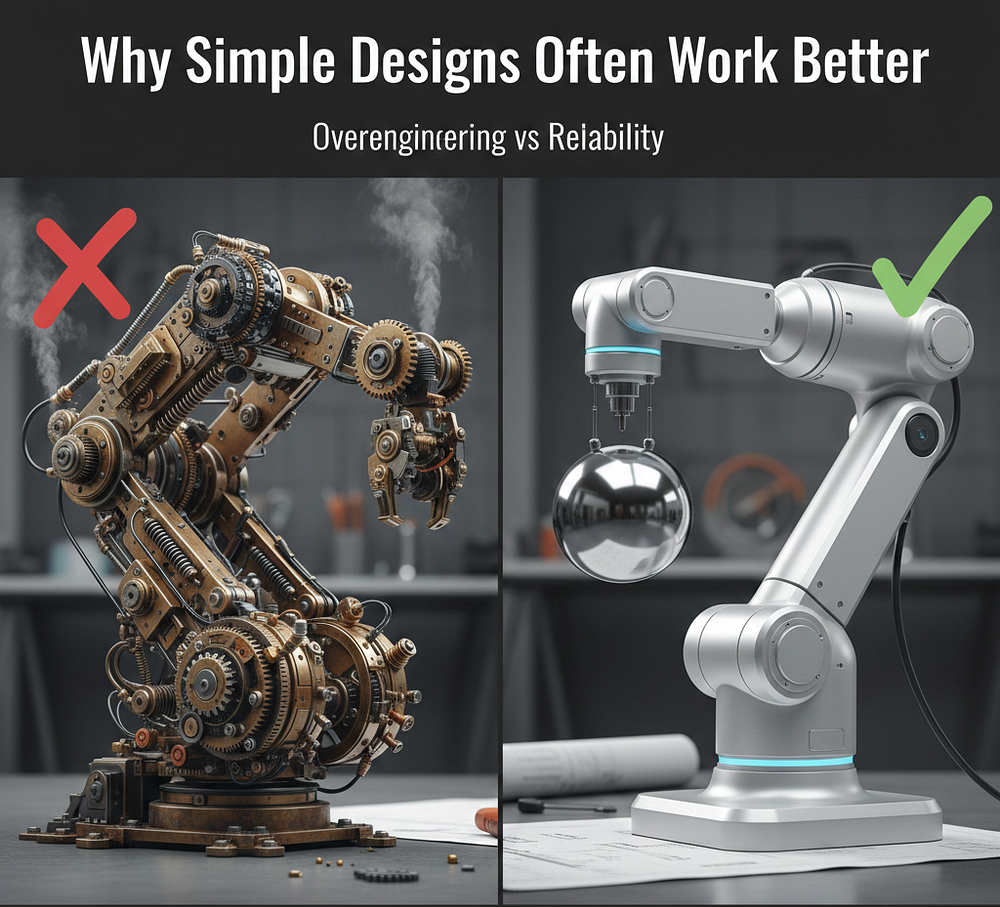
In engineering, there is a quiet temptation to add more. More features. More mechanisms. More intelligence. In student engineering competitions like NASA HERC, this temptation is especially strong. Complex designs often look impressive and feel innovative.
Yet experience consistently points to a different truth. Simple designs usually perform better.
The Appeal of Overengineering
Overengineering does not come from carelessness. It often comes from enthusiasm.
Teams want to explore ideas, push boundaries, and showcase skills. Adding features can feel like progress. Each addition seems to increase capability.
However, complexity introduces hidden costs. More components mean more points of failure. More interactions mean more unexpected behaviour.
NASA HERC makes these costs visible.
Complexity Multiplies Risk
Every added system interacts with existing ones.
A small design change can affect balance, power usage, thermal behaviour, or control logic. As complexity grows, predicting system behaviour becomes harder.
In challenging environments like uneven terrain, unpredictable interactions become magnified. Problems that seem minor in isolation combine into significant issues.
Simple systems are easier to understand, control, and recover.
Reliability Comes From Understanding
Reliable designs are not defined by how advanced they are. They are defined by how well they are understood.
Simple designs allow teams to fully understand how their rover behaves. That understanding leads to confidence, consistency, and faster troubleshooting.
When something goes wrong, simple systems are easier to diagnose and fix. Complexity often hides the root cause.
NASA HERC rewards systems that behave predictably under pressure.
Testing Favors Simplicity
Testing reveals the true cost of overengineering.
Complex designs require more extensive testing to validate every interaction. Limited time makes this difficult. Simple designs reach reliability faster because fewer variables are involved.
Iteration cycles are shorter. Improvements are easier to evaluate. Learning accelerates.
Teams that prioritise simplicity often test more effectively.
Simplicity Improves Consistency
In competition environments, consistency matters more than peak performance.
A rover that performs well every time is more valuable than one that performs exceptionally once. Simple designs are more likely to behave consistently.
They are less sensitive to small changes in terrain, power levels, or control input. This stability improves both scoring reliability and team confidence.
Consistency is a competitive advantage.
Operational Ease Matters
Operators interact directly with the rover.
Simple systems are easier to operate. Controls feel more intuitive. Responses are predictable. Decision-making becomes clearer under pressure.
Reducing operational complexity reduces mental load. This allows operators to focus on navigation and strategy rather than managing system behaviour.
NASA HERC evaluates performance holistically, including how smoothly systems are operated.
Choosing simplicity is not about lowering ambition. It is about prioritisation.
Every feature added should justify its cost. Does it genuinely improve performance? Does it increase reliability? Does it add unnecessary risk?
Thoughtful engineering involves knowing when not to add something. This judgement improves with experience.
NASA HERC teaches teams to make these trade-offs consciously.
Simplicity Does Not Mean Basic
Simple designs can still be sophisticated.
Elegance in engineering often comes from achieving goals with minimal complexity. These designs appear effortless but are carefully thought through.
Achieving simplicity requires understanding constraints deeply. It is often harder than adding features.
In this way, simplicity reflects maturity.
Team Mushak’s Perspective
Through experience, Team Mushak has learned to respect simplicity. We approach design decisions by asking whether an idea improves reliability or simply adds complexity.
This mindset helps us focus on what truly matters.
Engineering is not about how much can be added.
It is about how little is needed to achieve the goal reliably.
Simple designs often work better because they leave less room for failure and more room for understanding.
This is Team Mushak.
Learning through challenges.
Building through iteration.
And preparing, one step at a time, for NASA HERC 2026
TO SEE OUR JOURNEY YOU GUYS CAN STAY TUNED WITH US ON
1. YouTube: https://youtube.com/@teammushak?si=pyRJ3G6mEWIp_YXz
2. Instagram: https://www.instagram.com/teammushak?igsh=cDBmYmZxdGoyZGwz
3. LinkedIn: linkedin.com/in/team-mushak
4. Twitter https://x.com/mushak_herc


Comments
Post a Comment