Forces Acting on a Rover During Obstacles
Forces Acting on a Rover During Obstacles
Because every obstacle pushes back with physics.
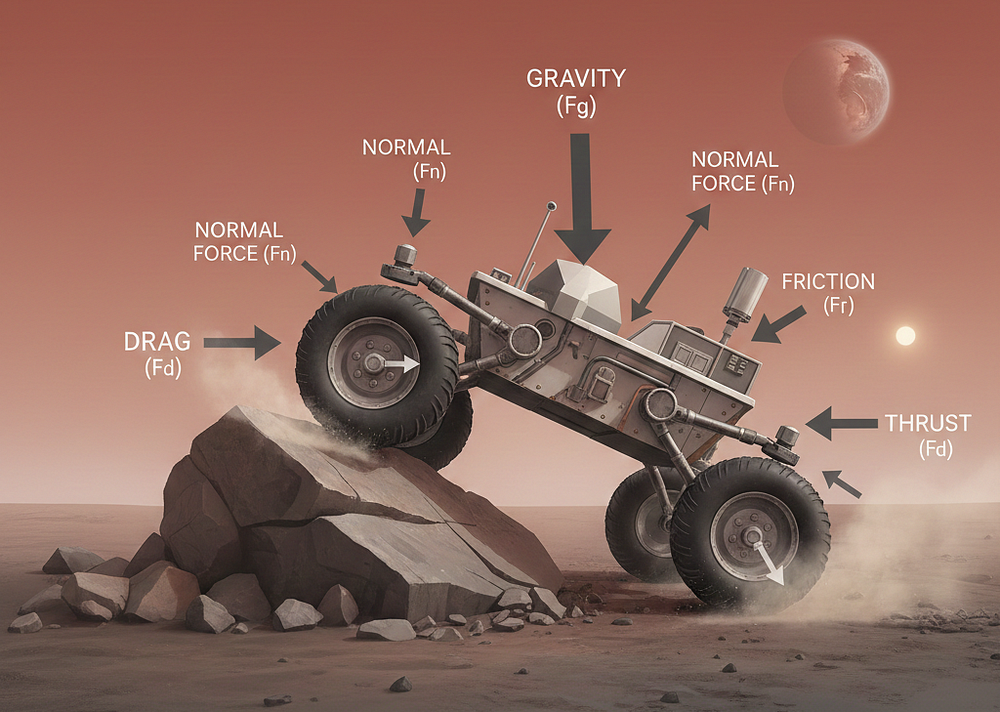
When a rover approaches an obstacle in the NASA Human Exploration Rover Challenge RC Division, it is not just climbing or turning. It is entering a complex interaction of forces. Gravity pulls, the ground reacts, wheels push, and the structure absorbs stress. None of these forces act alone.
Understanding these forces explains why rovers slow down on slopes, struggle on edges, and sometimes fail where the design seemed confident. Obstacles are not just physical challenges. They are physics problems in motion.
Gravity: The Constant Force You Can’t Escape
Gravity is always present, even when the rover appears still.
On flat ground, gravity acts straight downward and is balanced by the ground beneath the rover. On slopes and obstacles, gravity behaves differently. Part of it still presses the rover into the ground, but another part now works against forward motion.
As the rover climbs, gravity actively resists movement. The steeper the incline, the stronger this resisting effect becomes. This is why rovers slow naturally on slopes even when power input remains constant.
In NASA HERC, obstacles are designed to make gravity noticeable. They force teams to design with the understanding that gravity is not just holding the rover down — it is actively shaping how motion occurs.
Normal Force: How the Ground Pushes Back
The normal force is the ground’s response to gravity.
Whenever the rover presses down on the surface, the surface pushes back. This upward reaction force is what supports the rover and enables traction. Without it, wheels cannot generate usable grip.
During obstacles, the normal force is unevenly distributed. Some wheels may carry more load, while others carry less or lose contact entirely. This uneven distribution affects traction, stability, and control.
On steep slopes or sharp obstacles, changes in normal force can cause sudden loss of grip. A wheel that loses normal force cannot produce traction, no matter how strong the drive system is.
Normal force explains why contact matters as much as power.
Slope Forces and Load Transfer
When a rover climbs an incline, gravity can be split into components.
One part presses the rover into the surface. The other acts parallel to the slope, pulling the rover backward. This slope-parallel force increases with incline angle, making motion progressively harder.
At the same time, load transfers within the rover. Weight shifts toward the downhill wheels, changing how forces are distributed across the structure. This affects traction and stability simultaneously.
In NASA HERC, this load transfer is intentional. Obstacles reveal whether the rover handles shifting forces calmly or reacts unpredictably.
Designs that manage load transfer effectively remain stable. Designs that ignore it experience slip, hesitation, or tip risk.
Reaction Forces During Obstacle Contact
Obstacles introduce sudden reaction forces.
When a wheel hits an edge or climbs over a barrier, the contact force changes rapidly. These reaction forces travel through the wheel, suspension, and structure almost instantly.
If the structure cannot distribute these forces smoothly, stress concentrates in specific areas. This leads to flex, vibration, or mechanical failure over time.
Reaction forces also affect motion. A sudden upward reaction can reduce traction at other wheels. A poorly managed impact can disrupt balance and control.
NASA HERC obstacles are designed to expose how rovers absorb and redistribute these forces.
Why Forces Must Be Designed For, Not Corrected Later
Physics acts first. Control systems react afterward.
If mechanical design does not account for gravity, normal force variation, and slope forces, no amount of correction can fully compensate. Software cannot create traction where normal force is missing. It cannot cancel gravity.
This is why mechanical design carries the responsibility for force management. Structural layout, weight placement, wheel design, and suspension choices determine how forces behave before control systems respond.
NASA HERC reflects real engineering practice, where understanding forces prevents problems rather than reacting to them.
Obstacles are not just tests of power.
They are tests of understanding.
Every slope, edge, and impact introduces forces that demand respect. Rovers that succeed do not overpower these forces. They work with them.
In NASA HERC, physics is not an abstract concept.
It is the reason every obstacle feels harder than it looks.
This is Team Mushak.
Learning through challenges.
Building through iteration.
And preparing, one step at a time, for NASA HERC 2026
TO SEE OUR JOURNEY YOU GUYS CAN STAY TUNED WITH US ON
1. YouTube: https://youtube.com/@teammushak?si=pyRJ3G6mEWIp_YXz
2. Instagram: https://www.instagram.com/teammushak?igsh=cDBmYmZxdGoyZGwz
3. LinkedIn: linkedin.com/in/team-mushak
4. Twitter: https://x.com/mushak_herc
5. Blogger: https://teammushak.blogspot.com/2026/01/the-vision-behind-team-mushak.html
6.Medium: https://medium.com/@team.mushak/key-design-lessons-from-nasa-herc-2025-6a7c83a2ee73


Comments
Post a Comment