How Physics Shapes Every Decision in NASA HERC
How Physics Shapes Every Decision in NASA HERC
Before design. Before code. Before motion — physics decides.
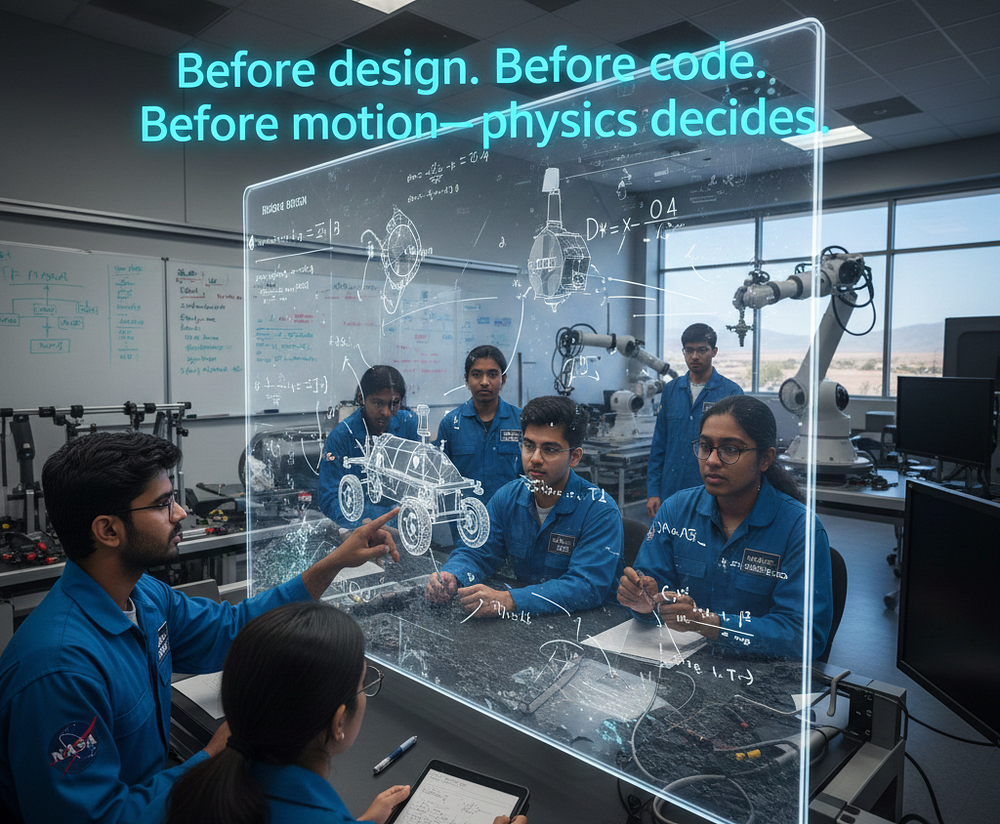
In the NASA Human Exploration Rover Challenge RC Division, success is often attributed to good design, smart control, or careful planning. But beneath every one of those lies something more fundamental. Physics shapes every decision long before the rover ever touches the course.
From the way a wheel grips the ground to how energy is consumed over time, physics quietly governs what is possible. Teams may negotiate with constraints, iterate through designs, and optimize systems, but they never escape physical laws. Understanding this reality transforms trial and error into engineering.
Physics Is the First Constraint, Not the Last
Before any design choice is made, physics has already set the limits.
Gravity defines how weight behaves on slopes. Friction determines whether traction exists. Force interactions decide how obstacles resist motion. These factors are not influenced by creativity or ambition. They exist independently of intent.
NASA HERC reveals this clearly. Designs that ignore physical limits struggle no matter how advanced they appear. Designs that respect these limits feel calm, predictable, and efficient.
Physics does not restrict innovation. It guides it.
Every Mechanical Choice Is a Physics Decision
Mechanical design is applied physics.
Decisions about structure, wheel geometry, suspension, and material choice directly affect how forces flow through the rover. Stability, balance, and control are not abstract qualities. They are outcomes of how physics is managed.
Center of mass placement influences tip risk. Structural rigidity affects load transfer. Wheel interaction shapes traction and slip. None of these are isolated choices. Each reflects an understanding of physical behavior.
NASA HERC encourages teams to think mechanically with physics in mind rather than correcting problems after they appear.
Energy and Power Reflect Physical Reality
Energy and power reveal how well physics is respected.
Battery-powered rovers operate under strict energy limits, while resistance from terrain is constant and unforgiving. Inefficient motion wastes energy that cannot be recovered.
High power usage may feel effective momentarily, but it often leads to rapid depletion and reduced reliability. Efficient systems move deliberately, conserve energy, and maintain performance over time.
NASA HERC teaches teams that managing physics well leads to longer, more consistent operation.
Control Systems Respond to Physics, Not the Other Way Around
Control is often misunderstood as authority.
In reality, control systems respond to physical behavior. They operate within boundaries defined by mass distribution, traction, and force interaction. Software cannot cancel gravity or create friction.
Effective control depends on mechanical and physical harmony. When systems are well-designed, control feels smooth and intuitive. When physical foundations are weak, control becomes reactive and strained.
NASA HERC reinforces that physics must be designed for before control strategies are written.
Testing Turns Physics Into Understanding
Physics becomes meaningful through testing.
Design assumptions dissolve when the rover interacts with terrain. Slopes reveal load transfer. Obstacles expose force paths. Motion highlights energy loss. These experiences turn theory into intuition.
NASA HERC values teams that observe carefully, document outcomes, and iterate responsibly. Testing is not about pushing limits blindly. It is about learning how physics behaves under real conditions.
Understanding replaces guesswork.
Why This Matters Beyond Competition
NASA HERC is more than a student challenge.
It reflects how real exploration systems are built. Space missions operate under extreme constraints where physics cannot be negotiated. Engineers succeed by understanding physical behavior deeply, not by attempting to bypass it.
The lessons learned here extend into any engineering field. Respecting physics leads to safer, more reliable, and more efficient systems.
HERC prepares students to think like engineers who work with reality, not against it.
What Physics Taught Team Mushak
For Team Mushak, physics reshaped how we approached every stage of design and testing.
We learned to prioritize balance over complexity, control over speed, and efficiency over brute force. Physics stopped feeling like a subject and started feeling like a collaborator.
This shift transformed how we prepare for NASA HERC 2026.
Physics does not reward effort.
It rewards understanding.
Every decision in NASA HERC — from design to testing to operation — is guided by physical laws that remain constant regardless of ambition. Teams that succeed are not those that fight these laws, but those that respect and apply them thoughtfully.
In NASA HERC, engineering begins not with tools or code.
It begins with physics.
This is Team Mushak.
Learning through challenges.
Building through iteration.
And preparing, one step at a time, for NASA HERC 2026
TO SEE OUR JOURNEY YOU GUYS CAN STAY TUNED WITH US ON
1. YouTube: https://youtube.com/@teammushak?si=pyRJ3G6mEWIp_YXz
2. Instagram: https://www.instagram.com/teammushak?igsh=cDBmYmZxdGoyZGwz
3. LinkedIn: linkedin.com/in/team-mushak
4. Twitter: https://x.com/mushak_herc
5. Blogger: https://teammushak.blogspot.com/2026/01/the-vision-behind-team-mushak.html
6.Medium: https://medium.com/@team.mushak/key-design-lessons-from-nasa-herc-2025-6a7c83a2ee73


Comments
Post a Comment