Managing Resources and Logistics for NASA HERC
Managing Resources and Logistics for NASA HERC
A rover isn’t just built with ideas — it’s built with organization.
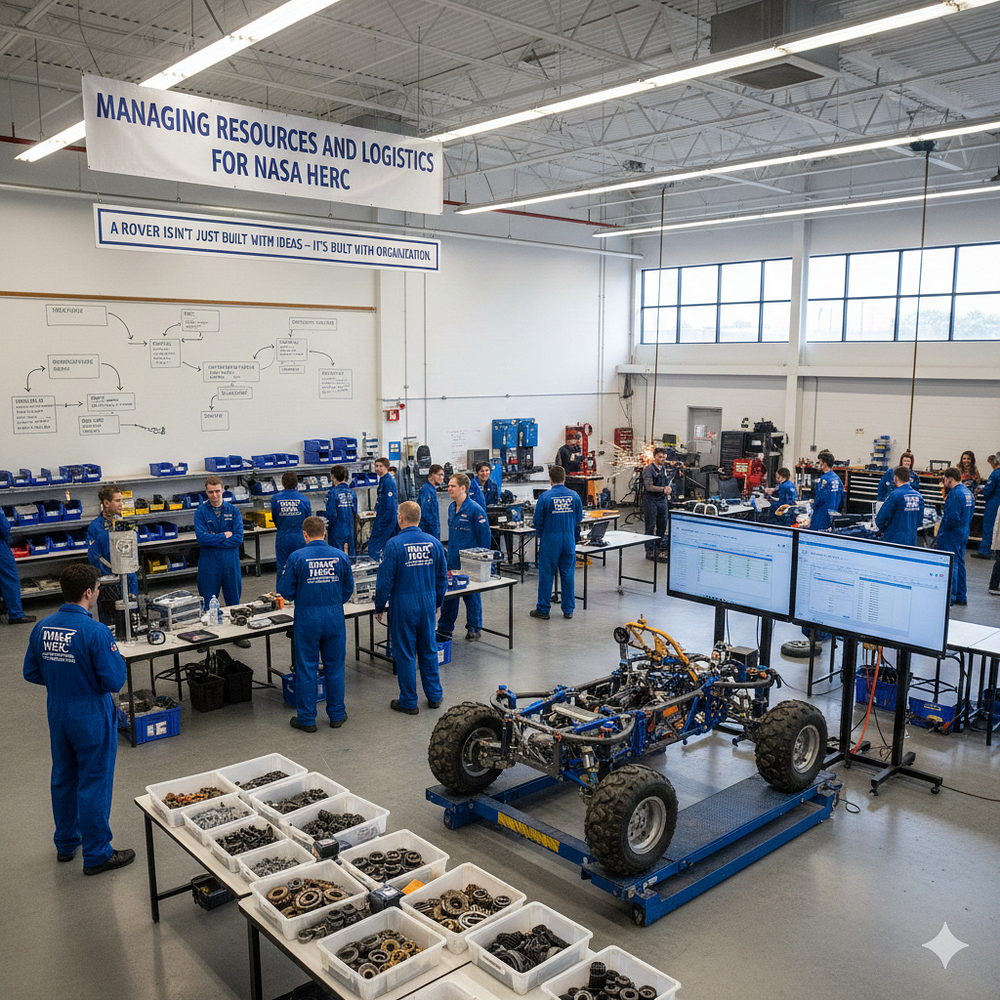
When people think of NASA HERC, they imagine CAD models, field testing, obstacle runs, and intense design discussions. What they don’t see is the invisible system working behind the scenes. The sourcing of components. The tracking of tools. The budgeting decisions. The storage organization. The procurement timelines. The transport planning.
In reality, a rover does not fail because of lack of passion. It fails when resources are unmanaged.
NASA HERC is as much about logistical precision as it is about engineering creativity.
Components: Planning Beyond the Purchase
Every bolt, motor, battery pack, structural plate, controller, sensor, and connector represents more than hardware. It represents planning.
Components cannot simply be ordered when needed. Lead times vary. Availability fluctuates. Unexpected delays happen. Good logistics means anticipating these uncertainties before they become problems.
At Team Mushak, component management begins during the design phase. Critical items are identified early. Alternatives are researched. Dependencies are mapped so that one missing part does not stall an entire subsystem.
This mindset reduces risk.
Because in a time-bound competition like NASA HERC, waiting on a single delayed shipment can derail weeks of progress.
Strategic procurement ensures engineering momentum remains uninterrupted.
Tools: The Silent Force Behind Precision
Tools are rarely celebrated, yet they define manufacturing accuracy and assembly reliability.
Organized tool access improves efficiency. Maintenance ensures safety. Clear storage and handling systems prevent damage and loss. Calibration checks protect measurement integrity.
Good logistics is not just about having tools. It is about knowing where they are, ensuring they function correctly, and making sure the right team members can access them when needed.
In a high-stakes build environment, time wasted searching for equipment accumulates quickly. Order creates speed. Discipline creates productivity.
Professional labs don’t run on improvisation. Neither does a NASA HERC team.
Budgeting: Engineering Within Limits
Constraints are part of NASA HERC, and budgeting is one of the most critical.
Resources are finite. Prioritization is unavoidable.
Every purchasing decision involves trade-offs. Is this component essential, or is it an upgrade? Can a design be optimized to reduce cost without reducing safety? Is reuse from previous iterations possible? Can parts be modular so that replacements are cheaper?
A strong budgeting mindset does not limit innovation. It makes innovation sharper.
When teams learn to operate within financial boundaries, they develop efficiency, creativity, and strategic discipline. These skills extend far beyond competition. They mirror real engineering environments where cost awareness is not optional.
Financial planning becomes an extension of technical thinking.
Inventory and Risk Management
NASA HERC builds are complex systems composed of multiple interconnected subsystems. That complexity must be matched with controlled organization.
Inventory tracking ensures awareness of quantities, spares, and replacements. High-risk components require backup planning. Critical parts are handled with extra caution. Consumables are monitored before they run out.
Risk assessment applies to logistics just as much as it does to engineering.
If a motor fails during testing, is a spare available? If a battery degrades, is a replacement ready? If a structural component cracks, is there raw material stocked for reconstruction?
Preparation reduces panic. Backup planning builds confidence.
In competition scenarios, resilience often comes from logistics, not just engineering excellence.
Planning for Transport and Event Readiness
NASA HERC does not only evaluate what is built. It evaluates readiness.
Transporting the rover safely, ensuring packaging protects sensitive electronics, preparing documentation, checking compliance materials, and organizing tools for on-site troubleshooting all require foresight.
Logistics extends from workshop to field.
A disorganized transport plan can undo months of meticulous preparation. Securing components, labeling equipment, verifying safety gear, and preparing contingency kits are all part of professional event readiness.
Execution on competition day depends heavily on preparation days before it.
Leadership Behind Operations
Effective logistics requires oversight, discipline, foresight, and constant monitoring. It requires someone who thinks ahead while the rest of the team focuses on building.
Logistics Manager Shout-Out
A massive appreciation goes to Ishpal Matharu, Logistics Manager of Team Mushak.

Behind every smoothly delivered component, organized storage setup, and prepared competition kit lies careful coordination and planning.
Ishpal ensures that engineering teams can focus on designing, assembling, and testing without disruption. By managing procurement timelines, tracking inventory, and planning operational flow, he provides the structural stability that allows innovation to happen confidently.
Because in a challenge like NASA HERC, progress is not only built. It is managed.
This is Team Mushak.
Learning through challenges.
Building through iteration.
And preparing, one step at a time, for NASA HERC 2026
TO SEE OUR JOURNEY YOU GUYS CAN STAY TUNED WITH US ON
1. YouTube: https://youtube.com/@teammushak?si=pyRJ3G6mEWIp_YXz
2. Instagram: https://www.instagram.com/teammushak?igsh=cDBmYmZxdGoyZGwz
3. LinkedIn: linkedin.com/in/team-mushak
4. Twitter: https://x.com/mushak_herc
5. Blogger: https://teammushak.blogspot.com/2026/01/the-vision-behind-team-mushak.html
6.Medium: https://medium.com/@team.mushak/key-design-lessons-from-nasa-herc-2025-6a7c83a2ee73


Comments
Post a Comment