Physics in Motion: Why Rovers Don’t Behave Like Cars
Physics in Motion: Why Rovers Don’t Behave Like Cars
Because the ground plays by different rules.
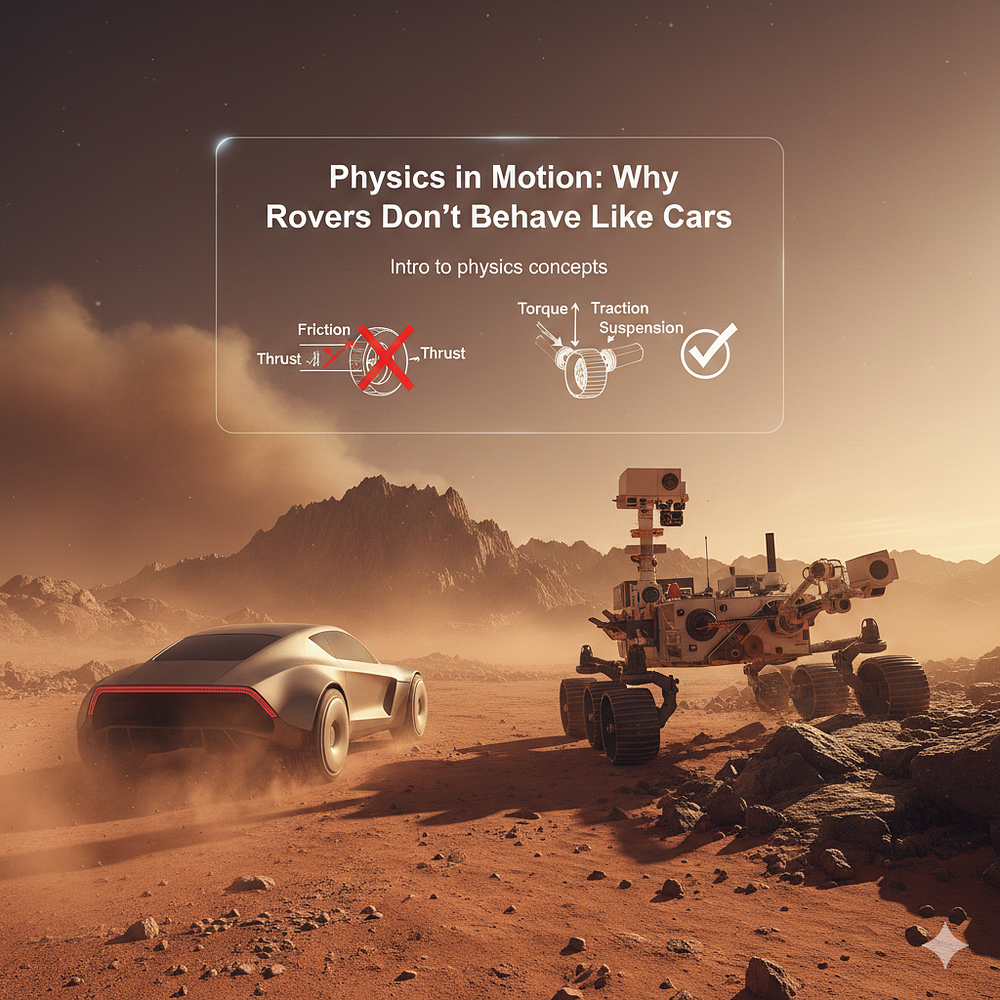
At first glance, a rover and a car seem similar. Both move on wheels. Both rely on traction, balance, and control. Yet when a rover enters a NASA Human Exploration Rover Challenge RC course, it quickly becomes clear that it does not behave like a car at all.
The difference lies in physics.
Rovers operate under conditions that magnify forces most vehicles are designed to avoid. Loose terrain, uneven surfaces, low speeds, and high torque demands change how motion works. Understanding this difference is essential to designing and controlling a rover effectively.
Traction Is Not Guaranteed
Cars are designed for prepared surfaces.
Roads are predictable, friction is consistent, and tires are optimized for grip. Rovers experience the opposite. Planetary terrain is uneven, loose, and constantly changing.
Traction becomes situational rather than constant. Wheels grip, slip, re-grip, and slide, sometimes within a single motion. This behaviour changes how acceleration and steering feel.
Physics shifts from smooth motion to negotiation with the surface.
Low Speed Changes Everything
Rovers move slowly by design.
At low speeds, inertia behaves differently. Small forces matter more. Resistance from terrain becomes dominant, while momentum contributes very little.
Cars rely on momentum to smooth movement. Rovers cannot.
This means rover motion depends heavily on torque rather than speed. Mechanical and control systems must work harder to initiate movement and maintain consistency.
Low-speed physics demands patience, not aggression.
Center of Mass Is Constantly Tested
Cars are designed with stability in mind.
Wide tracks, low centers of mass, and controlled environments reduce rollover risk. Rovers face uneven surfaces that shift weight unpredictably.
As the rover climbs, turns, or descends, its center of mass moves relative to the terrain. If not managed carefully, this can destabilize the system.
Physics is no longer passive. It actively challenges every movement.
Forces Travel Differently Through a Rover
In cars, suspensions and structures absorb forces smoothly.
In rovers, forces are transmitted more directly through the structure due to terrain roughness and low speed operation. Impacts, resistance, and uneven loads create sudden stress changes.
These forces influence wheel contact, stability, and control response. The rover reacts immediately to terrain inputs rather than averaging them out.
Understanding force paths becomes critical to reliable design.
Steering Isn’t Just About Direction
Turning a rover is not simply steering.
On uneven terrain, turning involves balancing traction, resisting slip, and managing load transfer. Sometimes a straight path requires correction, while a turn demands restraint.
Physics governs how friction, weight, and resistance interact. Oversteering can cause loss of control, while understeering can cause immobilization.
Rover steering is an exercise in compromise.
Why Physics Matters for HERC Design
NASA HERC exposes teams to physics in its raw form.
Design decisions that ignore physics often lead to unpredictable behaviour. Designs that respect physical constraints tend to perform consistently even under stress.
Physics explains why certain choices feel intuitive during testing while others fail repeatedly. It turns confusion into understanding.
For Team Mushak, recognizing these differences changed how we approached design and control.
From Classroom to Course
Physics in HERC is not about formulas.
It is about observation, adaptation, and respect for real-world behaviour. Concepts like friction, torque, balance, and force become visible through motion rather than calculation.
The rover becomes a moving demonstration of physics in action.
Rovers do not behave like cars because they are not meant to.
They are designed to operate where roads don’t exist and predictability fades. Physics steps forward, and assumptions step back.
At NASA HERC, understanding motion is less about speed and more about awareness.
And awareness is where engineering truly begins.
This is Team Mushak.
Learning through challenges.
Building through iteration.
And preparing, one step at a time, for NASA HERC 2026
TO SEE OUR JOURNEY YOU GUYS CAN STAY TUNED WITH US ON
1. YouTube: https://youtube.com/@teammushak?si=pyRJ3G6mEWIp_YXz
2. Instagram: https://www.instagram.com/teammushak?igsh=cDBmYmZxdGoyZGwz
3. LinkedIn: linkedin.com/in/team-mushak
4. Twitter: https://x.com/mushak_herc
5. Blogger: https://teammushak.blogspot.com/2026/01/the-vision-behind-team-mushak.html
6.Medium: https://medium.com/@team.mushak/key-design-lessons-from-nasa-herc-2025-6a7c83a2ee73


Comments
Post a Comment