Safety by Design: How Team Mushak Approaches Safety in NASA HERC
Safety by Design: How Team Mushak Approaches Safety in NASA HERC
Because a rover that isn’t safe isn’t engineered — no matter how well it performs.
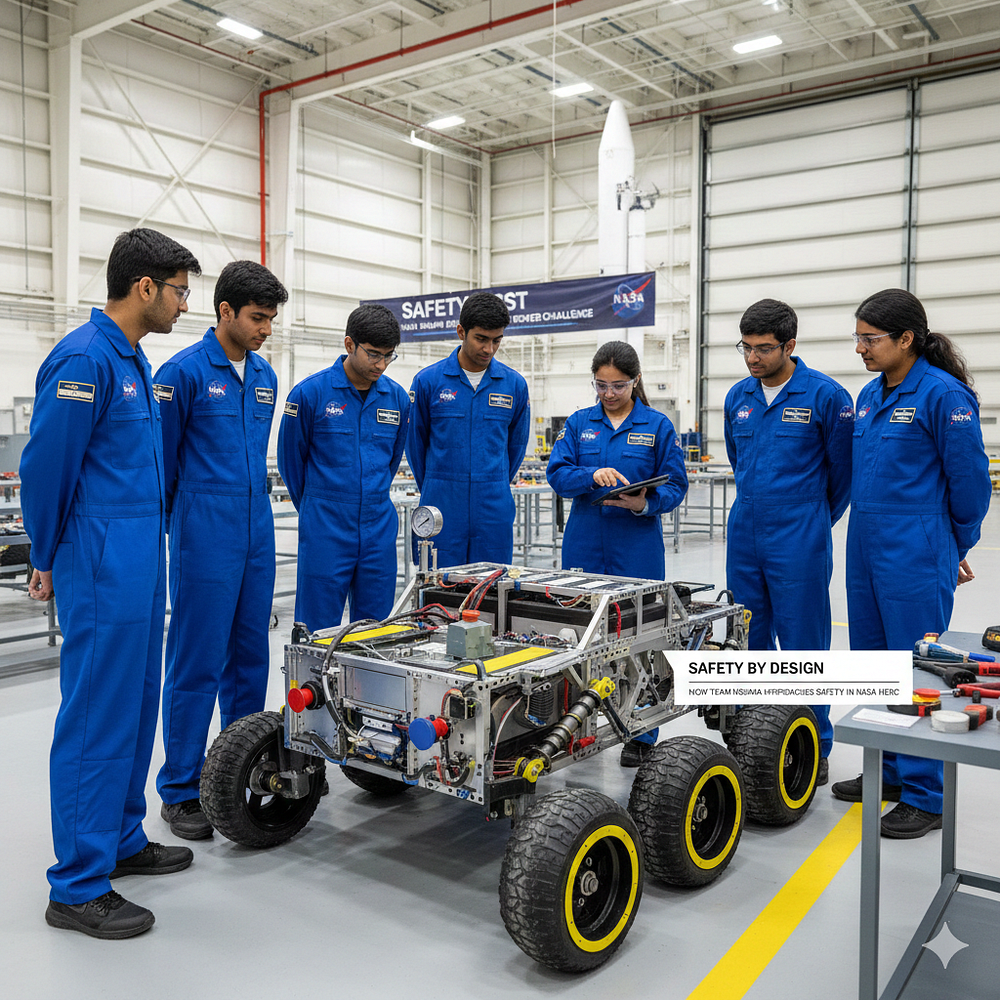
In engineering, safety is often misunderstood as something that comes after the design is complete. A set of checks. A final review. A form to be filled before approval. NASA HERC challenges that mindset entirely. Here, safety is not a phase at the end of the process. It is a requirement that shapes every decision from the very beginning.
For Team Mushak, safety is not treated as a limitation. It is treated as a design condition that defines how the rover is built, tested, and operated. Long before our rover reaches the course, safety has already influenced its structure, electronics, software behavior, and operational planning.
This approach aligns closely with the principles laid out in the NASA HERC 2026 Handbook, where safety is positioned as a foundational responsibility rather than a procedural obligation.
Designing With Safety, Not Around It
From the earliest concept discussions, safety is part of the design conversation.
When decisions are made about size, weight, materials, or layout, the question is never just “Will this work?” It is also “Will this behave predictably under stress?” Structural strength, weight balance, and stability are evaluated not only for performance, but for how they reduce risk during real operation.
Edges are designed to avoid hazards. Structures are reinforced where loads concentrate. Moving parts are planned with awareness of human interaction. These considerations are not added later. They are built into the design itself.
In NASA HERC, safety begins on the drawing board.
Electrical and Energy Safety as a System Responsibility
Electrical systems are among the highest-risk areas in any rover. Batteries, wiring, and power distribution must operate reliably under varying conditions.
Team Mushak approaches electrical safety with layered protection. Batteries are housed securely and insulated appropriately. Wiring is routed intentionally to avoid damage, overheating, or accidental contact. Protection mechanisms are included to ensure that faults do not cascade into larger failures.
Rather than assuming systems will behave perfectly, the design assumes things can go wrong — and prepares for that possibility. This mindset is at the heart of NASA-style engineering.
Software as a Safety Enforcer
Safety does not stop at hardware.
Software plays a crucial role in enforcing safe behavior across the rover. Speed limits are not left to human judgment alone. Motion constraints, controlled acceleration, and defined behaviors are built into logic.
Even during remote operation, software acts as a safeguard, ensuring that commands remain within safe boundaries. During autonomous tasks, this responsibility increases further, as the rover must execute actions reliably with minimal human intervention.
In Team Mushak’s workflow, software is not just about functionality. It is about protection — of the rover, the operators, and the competition environment.
Testing as Risk Discovery, Not Just Validation
Testing is where safety assumptions are challenged.
Real terrain introduces forces, vibrations, and behaviors that simulations cannot fully predict. Testing allows the team to observe how systems respond under load, how structures handle stress, and how control systems behave when conditions are not ideal.
Rather than treating test failures as setbacks, Team Mushak treats them as critical safety data. Each issue reveals a potential risk that can be addressed early, long before competition day.
This philosophy mirrors NASA’s own approach: fail early, learn thoroughly, and improve responsibly.
Operational Safety and Team Discipline
Safety extends beyond the rover itself. It includes how the team operates around it.
Clear roles, proper handling procedures, personal protective equipment, and disciplined operational behavior all contribute to a safe working environment. These practices ensure that engineering excellence does not come at the cost of well-being.
In NASA HERC, professionalism is reflected as much in how a team works as in what it builds.
Leadership Behind the Safety Culture
A strong safety culture does not happen accidentally. It requires oversight, consistency, and accountability.
Safety Officer Shout-Out
A special and well-deserved recognition goes to Shantanu Puthran, Safety Officer of Team Mushak.

His role extends far beyond compliance. By constantly evaluating risks, asking the uncomfortable questions, and ensuring that safety is never compromised for convenience, Shantanu has helped embed safety into the team’s engineering mindset.
Because of this leadership, safety is not a reminder within Team Mushak — it is a habit.
Why This Matters? NASA HERC does not reward unsafe innovation. It rewards responsible engineering.
A rover that performs well but violates safety principles is incomplete. A team that prioritizes safety demonstrates readiness not just for competition, but for real-world engineering challenges.
For Team Mushak, safety is not about avoiding penalties. It is about honoring the values behind exploration itself.
In NASA HERC, safety is not the absence of risk.
It is the presence of responsibility.
By treating safety as a design requirement rather than an afterthought, Team Mushak builds systems that are not only capable, but credible.
Because in engineering — and in exploration —
nothing matters more than bringing everyone home safe.
This is Team Mushak.
Learning through challenges.
Building through iteration.
And preparing, one step at a time, for NASA HERC 2026
TO SEE OUR JOURNEY YOU GUYS CAN STAY TUNED WITH US ON
1. YouTube: https://youtube.com/@teammushak?si=pyRJ3G6mEWIp_YXz
2. Instagram: https://www.instagram.com/teammushak?igsh=cDBmYmZxdGoyZGwz
3. LinkedIn: linkedin.com/in/team-mushak
4. Twitter: https://x.com/mushak_herc
5. Blogger: https://teammushak.blogspot.com/2026/01/the-vision-behind-team-mushak.html
6.Medium: https://medium.com/@team.mushak/key-design-lessons-from-nasa-herc-2025-6a7c83a2ee73


Comments
Post a Comment