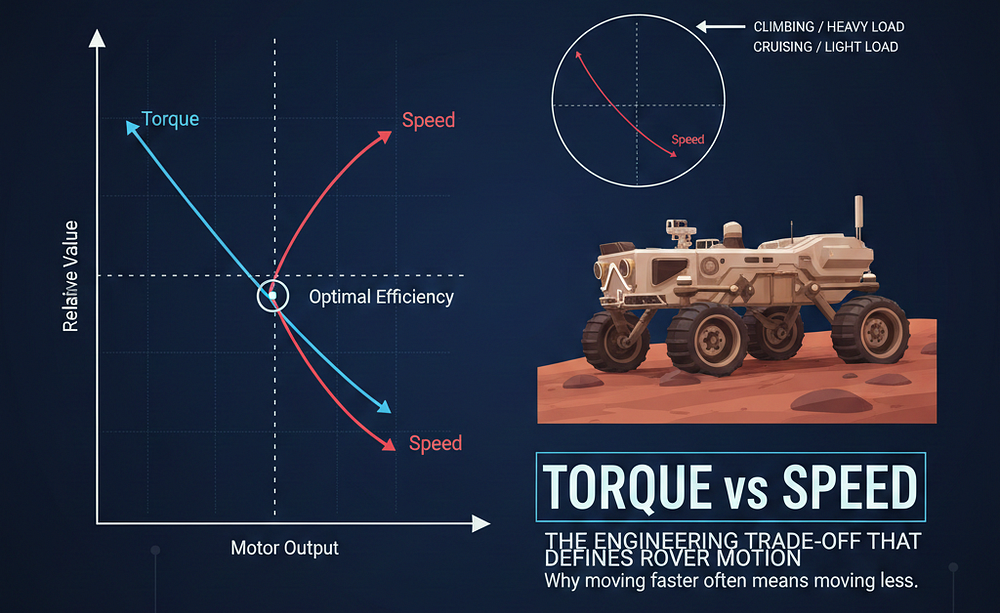
Torque vs Speed: The Engineering Trade-off That Defines Rover Motion
Torque vs Speed: The Engineering Trade-off That Defines Rover Motion
Why moving faster often means moving less.

In rover engineering, speed is tempting. Torque is essential. And balancing the two is one of the most constant design negotiations teams face in the NASA Human Exploration Rover Challenge RC Division.
Unlike road vehicles, rovers operate where resistance dominates motion. Every design decision related to power delivery shapes how the rover behaves on real terrain. Understanding the trade-off between torque and speed is not optional. It is foundational.
Why Speed Loses Its Advantage on Rough Terrain
Speed works well when resistance is predictable.
On roads, higher speed helps vehicles overcome minor irregularities through momentum. On rover terrain, this advantage disappears almost immediately. Loose surfaces, slopes, and obstacles dissipate energy faster than speed can compensate.
At low speeds, momentum contributes very little. Resistance becomes the dominant force. Trying to prioritize speed in this environment often results in wheel slip, instability, or complete loss of motion.
In NASA HERC, moving faster rarely means moving better.
Torque Is What Actually Creates Motion
Torque is the ability to apply force at the wheel.
It is what allows the rover to begin moving, climb obstacles, and resist resistance from uneven surfaces. On rough terrain, torque matters far more than top speed because it determines whether motion happens at all.
High torque enables controlled acceleration, predictable climbing, and steady movement under load. Without sufficient torque, even lightweight rovers struggle when terrain fights back.
This is why NASA HERC rovers are designed to feel deliberate rather than aggressive.
The Trade-off Can’t Be Escaped
Torque and speed are linked.
Increasing one almost always reduces the other within fixed constraints. Pushing for higher speed reduces available torque. Maximizing torque limits achievable speed. This is not a design flaw. It is a physical reality.
The challenge is not choosing torque or speed. It is deciding where on the spectrum the rover needs to operate reliably.
NASA HERC rewards rovers that choose wisely rather than ambitiously.
How the Trade-off Affects Control and Reliability
Power delivery shapes how controllable a rover feels.
Excessive speed reduces precision and increases reaction stress on mechanical systems. Low torque causes hesitation and stalling. Well-balanced systems feel calm, responsive, and predictable.
Torque-focused designs allow smoother starts, controlled turns, and gentler interaction with terrain. They reduce stress on structures, wheels, and suspension over repeated testing.
Reliability improves when the rover is not constantly operating near its limits.
Designing for Outcomes, Not Numbers
It is easy to chase specifications.
Higher RPMs, faster response, and impressive figures look appealing on paper. But rover success is measured by consistency, not peak performance.
Effective NASA HERC designs prioritize movement that is repeatable, controllable, and energy-efficient. Torque is selected not to dominate terrain, but to cooperate with it.
Engineering maturity appears when teams stop asking, “How fast can it go?”
and start asking, “How reliably can it move?”
In rover engineering, speed is visible.
Torque is invisible — but decisive.
NASA HERC teaches teams that motion is earned through control, patience, and balance. The most successful rovers are not the fastest. They are the ones that keep moving when the terrain pushes back.
Torque defines possibility.
Speed defines limits.
Engineering lives in the space between them.
This is Team Mushak.
Learning through challenges.
Building through iteration.
And preparing, one step at a time, for NASA HERC 2026
TO SEE OUR JOURNEY YOU GUYS CAN STAY TUNED WITH US ON
1. YouTube: https://youtube.com/@teammushak?si=pyRJ3G6mEWIp_YXz
2. Instagram: https://www.instagram.com/teammushak?igsh=cDBmYmZxdGoyZGwz
3. LinkedIn: linkedin.com/in/team-mushak
4. Twitter: https://x.com/mushak_herc
5. Blogger: https://teammushak.blogspot.com/2026/01/the-vision-behind-team-mushak.html
6.Medium: https://medium.com/@team.mushak/key-design-lessons-from-nasa-herc-2025-6a7c83a2ee73


Comments
Post a Comment